Money Talks. The Dog Barks. Motivation and Vocation

A few days ago the British Government published a Review on Antimicrobial Resistance . It described the growing resistance of bacteria to over-prescribed antibiotics and suggested that by 2050 a death from hitherto treatable bacterial infections might occur every three seconds, unless new drugs are discovered. It also urged huge investment in research, including the offering of large prizes (a billion US dollars) to pharmaceutical companies  for every new antibiotic they discover. But these vast prizes are insignificant compared to the cost of medicine being thrown back into the dark ages by recalcitrant bacteria.

It is pointless, as some do, to rail against the rapacious selfishness of pharmaceutical companies and expect them to undertake difficult and commercially risky research without incentives.

The report also urged doctors to prescribe fewer antibiotics, and to avoid prescribing antibiotics for infections that are viral. (Here in the Czech Republic there’s a tendency (admittedly now declining) to prescribe antibiotics as a precaution, to prevent a viral cold from turning into a bacterial cough.)

For many years (perhaps even decades) GPs in the UK have been asked to prescribe fewer antibiotics but are understandably upset when patient satisfaction declines. Nevertheless, data from the NHS were published yesterday that showed that doctors had prescribed 7%fewer antibiotics in the last year than during the preceding year.

How was this achieved? Through financial incentives. Some doctors’ practices were awarded 20,000 GBP bonuses, in effect for doing less.

greedydoctor

Money talks. Or as the Hungarians say – Money Talks, the Dog Barks.

We don’t like to think that financial incentives play an important role in motivating practitioners of vocational professions. The decisions of doctors, nurses, teachers and priests are not, we like to suppose, influenced by personal financial gain.  Decisions must always be made on the merits of each case.

But we know that the priest will do us a better wedding or baptation, the nurse’s hands will be softer and the doctor will see us sooner if we oil the wheels a little.

Here in Eastern Europe from 1948 until 1989 society was inspired by the utopian ideal that each of us would eagerly give ‘according to his ability to each according to his need.’ It didn’t work.

We have to accept that money motivates. If you’re managing a company, you must take account of dozens of factors when deciding how to motivate your staff, but if the money is insufficient, none of the other tricks will work – whether you’re juggling with job title, benefits (such as a company car), training, or responsibility. Even if staff say that the ‘money doesn’t really matter,’ they’ll still agree that money is a kind of recognition, whatever uses it’s put to.

You’ve got to accept that money is an incentive, and when you’re devising your incentives you’ve got to be careful. The NHS in the UK, I believe, will reward doctors for diagnosing and prescribing pills for blood pressure, and reward them for not prescribing antibiotics. The rules of the game have got to be sophisticated enough to achieve the right result but not so complex as to confuse,  or be beyond efficient measurement. And there are always the unintended, unanticipated effects of motivation that solve one problem and create another.

But sometimes incentives go too far. My mother is currently  being hounded by her young GP (probably recently married with a kid to support), who claims she’s diabetic, and, judging by the frequency with which she tells me this, it has disturbed her peace of mind.  She’s used a home-diagnostic kit to prove him wrong. Very likely he’d collect a bonus for adding her to the list of Type-2 diabetics, but he’s not going to get away with it.

Money talks. The dog barks. It will always be so. And if it reduces the risk that antibiotics will fail, who cares?


Dirt

When I was a very young child my mother used to say, ‘You’ve got to eat a peck of dirt before you die.’ I didn’t then know what she meant, nor picked up the context in which she said it, so I imagined a final ritual that involved the picking up and consumption of a small amount of soil. Being of a precociously logical disposition it also occurred to me that if avoided ingesting soil I might live forever.

We lived in the country, and there was dirt aplenty in the garden. Soft, gritty, not unpalatable. The ‘pecking’ aspect confused me, though. We kept hens and I understood what it meant to peck. Hens pecked at dirt continuously, even appeared to be eating it, courting, I supposed, an early demise. But in the absence of beaks, I couldn’t see how how we might do it.

I came to understand the meaning eventually, and agree wholeheartedly with both its metaphorical and its literal intent. Indeed sometimes I feel we don’t eat enough dirt. People are absurdly squeamish about cleanliness. If I drop food on the kitchen floor, I’ll happily pick it up and eat it. I don’t scour and swab my kitchen surfaces obsessively with industrial-grade disinfectants, in fear of bacteria. I’ll happily live with domestic animals without worrying about fur and hair. I wash my hands only when I should (see below). And I don’t mind dogs in restaurants or feeding them from the table.

I’ve no idea whether it’s true that overly zealous cleaning renders us vulnerable to bacteria and allergies, but people often say it. It may be one of those dubious factoids. But it makes a kind of sense, though has disturbing reverberations of homeopathic theory (dirt cures dirt). But whatever the truth of this, why waste so much time with dishcloth, bucket, mop, scrubbing brush, bleach, scouring powder and detergent? There are better things to do.

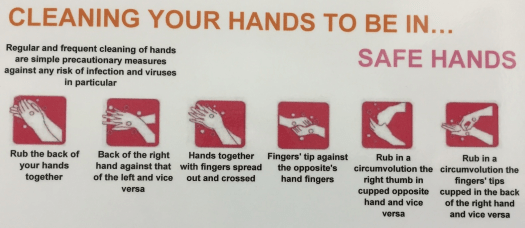
Some employers see it as their duty to enjoin hygienic behaviour on their employees. This notice, sent to me by my brother,  and posted in the lavatories of the bank he works for, gives us remarkably detailed instructions on how we should wash our hands. Banks are, after all, often in the business of laundry.

cleaning.png

Paradoxically, soil might be our saviour. Or at least it’s sometimes mentioned as such, with great fanfare. I was thinking of this when I read, yet again, in last week’s British papers the usual story about the ‘end of antibiotics.’ The tabloids reach for this alarmist notion every three or four months. Bacteria, we are told, are fighting back. The fittest of them have survived the onslaught of antibiotics, developing resistance as a result of our foolish overuse use of them, or incorrect use  (YOU MUST FINISH THE COURSE). I have no doubt it is true.

But, as I recall, the papers also regularly publish another contrasting ‘good news’ story, that researchers have found whole classes of new antibiotics by delving into dirt, where antibiotics of miraculous capability lurk in the microbes that inhabit soil.

What to believe?

Look at this story, for example, from January:

http://www.bbc.com/news/health-30657486

I am an optimist. A peck of soil will be our saviour. Be grateful to dirt.

Reasons to be cheerful

Returning from a hard day’s work at the excavations of Tutankhamen’s tomb in the Valley of the Kings in March 1923, George Herbert, 5th Earl of Carnarvon, took the top off a recent mosquito bite whilst shaving in the bathroom of his suite at the Winter Palace Hotel in Luxor. Overwhelmed by bacteria, he died in Cairo just over two weeks later.

Some put it down to the ‘Mummy’s Curse’, but whatever the cause, he was vulnerable, as all humanity was before the advent of antibiotics, to accidental and catastrophic bacterial infection.

Until last week we were led to believe that we would all have to be more careful shaving, as bacteria learn resistance to antibiotics and graduate to superbugdom. The age of antibiotics was said to be approaching its end.

So, it’s wonderful news that the first new class of antibiotics for thirty years has been discovered and has proved effective in mice. There may even be plenty more where this class comes from (soil), and they may be of a type that bacteria won’t so easily acquire resistance to.

It’s true that we don’t yet know if this substance will work on humans, but if not this time, and this type, then another time and type.

I am an optimist, and this announcement encourages me. The world has become a much better place over the last few decades and it goes on getting better. I have boundless faith in human ingenuity. I believe even the miseries of cancer and other medical horrors might one day be things of the past (though the miseries of human unpleasantness may prove more intractable).

But whilst the world is getting better, it’s also getting warmer. If we’re quick enough though, perhaps we’ll even solve that problem. Controlled nuclear fusion is on the way (just another decade or two), and then, surely, there will be enough green (nuclear) energy to power vast arrays of air conditioners blasting cold air into the skies. Or something similar.