The Artificial and the Natural

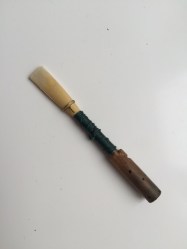
Playing the oboe is difficult. It’s a woodwind instrument topped with a double reed made of cane, wire, cord, cork, nail varnish, beeswax and brass. When the reed is working well the oboe makes a beguiling and plaintive sound (think of the solo from Swan Lake or at the start of the slow movement of Brahms’ Violin Concerto). Played inexpertly the sound can weaken concrete. Most parents don’t have the patience for it, nor can most afford the isolated farmhouse that it requires, which is one of the reasons why so few children learn how to play it and why almost all oboists were brought up in the countryside. It’s said that 10,000 hours of practice can make you an expert at anything. Your first 8,000 hours on the oboe should be spent in solitary confinement.
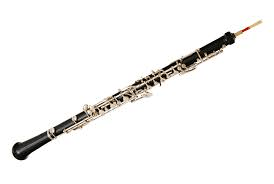
oboe

oboereed

Putting others’ aural comfort aside, the challenge of the oboe is that if you want to play it well you’ve got to make your own reeds, or, at the very least, have the skills to adjust them if others have made them for you. You have to be a craftsman as well as a musician. If you’re a flautist you can simply pick up your flute and play it. There’s no fussing about with a box of DIY tools. In fact, there’s no other instrument I can think of that involves such pernickety fiddling about with bits of cane, and wire, and cork and knives. It’s as if you should know how to make corsets in order to function as a barrister. True, playing any musical instrument involves a certain amount of manual dexterity, but that’s a different thing from taking tube cane, splitting it, gouging it, shaping it, binding it and scraping it. Lucky indeed is the oboist who’s a good craftsman, luckier still the oboist who enjoys the craft of reed-making. If he or she is a good oboist and musician too, it’s like winning the Euromillions Lottery.
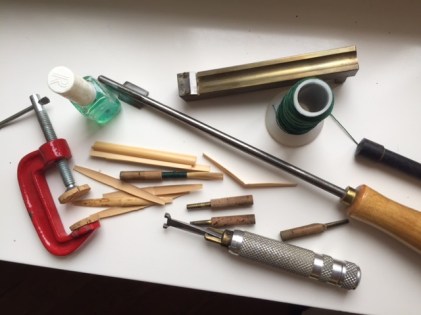
reedmaking

I make my own reeds. I was taught how to do it by my wonderful oboe teacher, Douglas Heffer, more than forty-two years go. I still hate doing it, but I can’t play on anyone else’s. Each one can take me an hour or so to make and test, and only one in eight (a low hit rate – some oboists achieve one in four) works well enough. Worse still, when you’ve made yourself a good one, it lasts just a week or so in peak condition. They’re fragile and organic, and they’re gradually digested by saliva. The mouth isn’t a good place to put a natural substance, but as far as I know you can’t play the oboe in any other way.

So, we oboists have dreamt of the artificial oboe reed – the ‘plastic reed’ impervious to saliva and time. Clarinettists already have them (but theirs is a single reed rather than a double) and bassoonists are starting to use them too. Both of these types are much larger, and the higher margin of error means that artificial clarinet and bassoon reeds have been easier to develop.  And even if they’re not using artificial reeds, bassoonists and clarinettists can buy reliable natural ones made by others. They don’t need to be craftspeople.

So, we oboists have been excited recently by the launch of the ‘plastic oboe reed’ by Légère, and I went to the oboe shop, Howarth, in London, with my oboe-playing friend Caroline, to try one out, in the hope that for the rest of my life I might never have to make another reed. Mind you, they’re expensive, but I and most oboists would sell half of what we possess, as well as our souls to the devil, for a reliable supply of pick-up-and-play, last-forever oboe reeds.
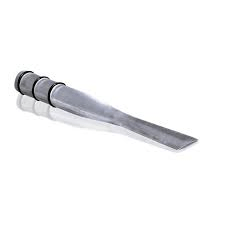
legere

And, they’re not bad at all. I think I could get used to them. The ‘scrape’ has a different contour to mine, and the sound is a remoter, mellower, more closed sound than mine, but I think I could get used to that, if others could.  I also understand that they can be adjusted slightly, if you’re nice to Ollie, who works at Howarth, but once you’ve adjusted them you can get months, even years, of life out of just one. I’d wondered what it would feel and taste like to put something dry and artificial in the mouth but it felt just the same as the natural ones. So, I’ve ordered four. Why four? You’d think they would be identical, since they’re made out of the same substance by a machine, but apparently they can be hit and miss. And at more than one hundred pounds each, and with a waiting list,  I thought I’d improve my odds by buying in bulk, and trust that Ollie won’t ruin them all.

And it doesn’t’ stop there when it comes to oboes and the artificial. Oboes are traditionally made of a very hard wood called African Blackwood that sinks in water, and is so close-grained that it looks and feels like stone, but the mischievous Michael Britton, who runs Howarth, and whom I’ve known for 35 years, brought out a swirly purple ebonite oboe for me to try. Ebonite is a hard plastic that’s closely related to kryptonite (apparently), or Bakelite, the hard stuff that old-fashioned telephones were made of. Howarth have made just two of them, and they’ve both been kitsched up with gold key work.. If Liberace had played the oboe, not the piano, this would have been the model he would have chosen. But, to my very great surprise, it played remarkably well, though at 14,000 pounds, I don’t think I’ll be buying one tomorrow.

It’s a myth that natural is always best. Let plastic reign.


Music and Dignity

I love to see pianos played in public places, and, of course, other instruments too. Over the last few years I’ve seen more and more pianos, some of dubious quality and provenance, in railway stations and airports.

On Saturday I saw someone play jazz (very well) on a piano at Avignon station, and later a teenager practising a chromatic scale (very badly) at Charles de Gaulle airport. And when I was last in Sofia I admired this lonely, unplayed Steinway and its incongruous ‘piano stool’ at the airport, but sadly, there was nobody to play it, and no one, I think, would want to hear what I can do.

sofia piano

Live music, wherever it is, in the concert hall or the departure lounge, is always preferable to the piped variety. I’d put my own Bluthner grand piano in the street outside my apartment if only I could get it through the window. It would probably get more playing there than in my living room.

People often think that classical music should be played with a special kind of dignity, in sombre, old-fashioned, uncomfortable, expensive clothes, in sombre, silent, sepulchral halls. We forget that it’s ‘entertainment’, by which I don’t mean that it isn’t serious or intelligent. It’s entertainment because it’s played for, or to, an audience, and audiences can be found anywhere.

Most of the time classical music is played as if it’s a ritual, whose moves are known only to a few initiates, and as if its practitioners are unapproachable high priests, even Gods, remote and full of dignity. It’s usually played in sterile ‘laboratory’ conditions, in an inert and unvarying atmosphere, where performers and audience are set decisively apart. Heaven forbid that you should clap at the wrong time or show too much emotion as you sit and absorb what the musicians are doing in front of you. Small wonder that when this is the prevailing style, audiences are sparse, and elderly.

Why should we listen to music in just one way? We eat in restaurants, on the street, at home, even at 30,000 feet. Every new location adds something different to the experience. Food tastes different in the open air. A Beethoven sonata, taking us by surprise on the concourse of a railway station, comes at us in a different way, catches us in a different frame of mind. And for the performer, too, it can be exciting to play for different audiences in different places. Why should the experience of performing and listening be confined only to a few locations?

Classical music needs to be stripped of its excessive dignity. At its best it’s an informal, warm, living, exciting, entertaining, even challenging, activity that’s performed by people for people, the one lot ‘saying something’ to the other, and the other responding with appreciation, delight, or sympathy. Music, at least in the form of singing (or howling!), was probably the precursor of speech. Music is communication of an elemental kind.

The fact that music is entertainment doesn’t mean it can’t be serious. I mean ‘entertain’ in the broad sense of capturing the attention of an audience. In this sense both Hedda Gabler and Absolutely Fabulous are entertainments. Seriousness needn’t be pompous, needn’t be surrounded by too much dignity. You can play Beethoven just as well in blue jeans as in a dinner jacket.

When I played my oboe regularly in amateur orchestras in London in the 1980s we often performed in busker venues, such as in the piazza at Covent Garden, and these performances were as serious, and as much fun as any in a concert hall. Never mind that some people came and went, that others stayed, that the applause came at the ‘wrong’ moments, I’m sure we said as much as we ever said in the frigid conditions of the concert hall.

So, I love the pianos that we see in public places, where the public are invited to perform any music that comes to mind. Sometimes it’s jazz, sometimes (too often) it’s Fur Elise, and sometimes it’s deeply serious music. When my nephew Frederic played some Chopin at Herne Hill Station in London, a small crowd gathered and applauded. I would love to come across Alfred Brendel or Andras Schiff playing at St Pancras station or on this Steinway at Sofia Airport. I hope that they could dispense with the dignity they’re used to.

But, for some players, music is so special that it’s no longer part of life. It’s something separate, dignified, dead. There’s a young pianist I know in Prague who takes himself too seriously. He’s good, and has played as a soloist with many famous orchestras. Though he has a magisterial way with Brahms, he’d be a happier man if he could lighten up a little. I invited him to my annual Christmas Party, which is also a Birthday Party for my partner. As I lit the candles on the birthday cake (a little the worse for drink, I will admit), I asked him, on an impulse, to play ‘Happy Birthday’ on the Bluthner grand. I knew immediately it was a faux pas of colossal proportions. He actually shuddered, as if I’d put something nasty under his nose. Too much dignity!

If Leonard Bernstein were my guest (sadly, he never will be now, because he’s dead), I wouldn’t even need to ask. It would be difficult to get him to stop. Music infused every moment of his life, not just those moments in the concert hall, and he didn’t give a damn about dignity.