Neither Shaken Nor Stirred

When I was sent by my employer as a business systems consultant to Hungary in the summer of 1987, the more mischievous amongst my friends put it about that I’d been dispatched on Her Majesty’s Secret Service to bring an end to Communism in the Eastern Bloc. It’s true that a manufacturing control system, properly implemented, is a formidable weapon, and perhaps it really was the efficiency that our system brought to the Videoton Television Factory in Szekesfehervar that was the last straw to break the Soviet camel’s back. In any case the unpredicted revolutions of 1989, which I witnessed merely as a bystander, did little to dispel the myth of my clandestine involvement.

In fact I possess most of the qualifications you need to be a British secret agent: ten years of private boarding-school education; three years at Oxford (the Uni not the Poly); an unwavering faith in democracy and the Rights of Man (and of Women, too, if absolutely necessary), tempered, of course, with a sense of the majesty of monarchy; a superb physique; a sneering disdain for oligarchs and other kinds of villain; a complete indifference to personal discomfort, tempered with an occasional taste for luxury, especially if enjoyed at others’ expense; a dapper manner in a dinner suit; enormous physical courage;  a sneering contempt for aggressive tax avoidance and its evil twin sister, evasion; a dislike of petting on the football field; a laconic wit; and a capacity for sudden and explosive violence. I could go on, but these are surely qualifications enough. Perhaps I fall a little short in the ‘Bond girl’ department, but I understand that’s never been an impediment in the Service. Far from it.

I’m not a fan of the vodka Martini either, my tipple being tea, as long as it’s not Darjeeling. So if we need a little catchphrase it’s more likely to be ‘neither one lump nor two, my dear’ than ‘shaken not stirred.’

Sadly the call has never come, though I did once fall under suspicion on a train between Budapest and Bucharest, and was questioned at length by a sneering man from the Romanian securitate. He was as eccentric and villainous a villain as you’ve ever seen in a Bond film  I threw him out of the window.

So where would be a more appropriate place to ski, this year, for a secret agent manqué, than Sölden, where parts of Spectre, the last James Bond film, were made last January. In retrospect I’m sorry I missed the chance, a year ago, when I was last here, to make progress with my project of putting the timesheet at the centre of the next Bond film. If you remember, I wrote to Barbara Broccoli, the producer of the Bond franchise, last summer, with an offer of a product placement for time@work, and I included some snappy dialogue to make our timesheets feel natural, free of charge. I thought it an imaginative and generous offer, but I’ve yet to receive a reply (see Bond, Where is that Timesheet?!).

Sölden is completely Bond mad this year, and you can even buy a Bond-branded ski-suit, complete with replica handgun, at the better sports outfitters in the town. I couldn’t resist the temptation. Here I am, in action.

bondadam4

I enjoyed Spectre, though I felt it lacked the sentimental realism and emotional pathos of Skyfall. I particularly enjoyed the larger part that Q played in the drama. It’s more about brain than brawn these days, when it comes to thwarting arch-villains bent on global conquest, so I shan’t really mind in the least if Ben Whishaw manages gradually to steal the limelight from Daniel Craig.

Daniel Craig as Bond

bondbond.jpg

Ben Whishaw as Q. (He’s the nerd for me!)

ben whishaw

And just a quick note, Ms Broccoli, in case you’re reading this. If you’ve a bit part for another action hero (with brains) in the next Bond film, then you may well find that I’m available. I’ll await your call.

Bond, where is that Timesheet?!

Share

I saw Spectre last night. It was utterly awesome, as I’d expected. Indeed, the Bond series goes from strength to strength. Perhaps it lacked the emotional range of Skyfall, and in particular, those moments of poignancy with which the film ended, but Spectre, just like its predecessors, is brim full of realistic and tasty ingredients – suspense, violence, innate evil, fast cars, gadgets, elegance, intimacy, torture and a soupcon of British humour. Director Sam Mendes lovingly recreates the old clichés and conventions, but despite all that I kept sensing that something hugely important was missing. I don’t mean Judi Dench. I miss her as M, of course, and I cried when M died, but Ralph Fiennes is a more than adequate replacement. And Ben Whishaw is superb as Q, this time a little more involved in the action. No, what I missed was timesheets and expenses.

I was so excited by the product placements in Skyfall that I actually wrote to the producer, Barbara Broccoli, to suggest that timesheets and expense forms might add some corporate plausibility to the image of MI6. After all, MPs at the House of Commons use our software, so why shouldn’t secret agents and their masters? Licensed to kill they may be, but surely they must account fully for each working day, and record their quite extravagant expenses properly if they’re expecting to be reimbursed.

I wrote to suggest three placement points and some clever and snappy dialogue to make them seem natural.

==

Memo to Barbara Broccoli, Producer, James Bond films:

Re:         Placement opportunities for systems@work in the next Bond film

Dear Barbara,

I have long admired the Bond franchise’s approach to product placement. Apart from lending credibility to the script at vital moments, they add further to the excitement (the audience wondering when, where, and how, the familiar products will make their ritualistic appearances). I understand that you make generous payments to the likes of Aston Martin, Sony and Omega to use and show their products. I can better that. I am prepared to let you show our systems and use our logos free of charge.

I see three opportunities for placement points in the forthcoming production where we can do something plausible and useful with timesheets and expenses:

  1. Near the beginning, when Q is doing his usual stuff with gadgets,
  2. Later, at an elegant location, when Bond is buying a Martini at a hotel bar, and
  3. Most appropriately, during the debriefing session at the end – M, Q, the Home Secretary, Moneypenny and Bond, all joshing on the subject of timesheets and expenses.

Moreover, I’ve taken the trouble to offer you, at no extra cost, some snappy dialogue designed to promote the benefits of timesheets and expenses without disturbing the excitement and momentum of the film.

==

Gadget Scene

(Q and Bond)

Bond     What’s my mobile in this one, Q? Any chance I’ll get an iPhone?

Q:          It’s still a Sony, I’m afraid, 007. Apple is too damn expensive.

Bond:    Apps?

Q:          Explodes. Shoots. Plays background music. Bowls a good leg break. Everything you need, 007.

Bond:    Very useful, Q, but what about expenses?

(Q angles the phone towards the camera so that we can see the screen.)

Q:         Yes, 007, we thought of that. No excuses for late submission this time. The systems@work App lets you do your expenses both offline and online. Snap your receipts with the inbuilt camera and forget about the paperwork. Upload them at your leisure, if you get any, but only (chuckles) if they’re MI6-compliant. No pigeon houses or moat cleaning at MI6, 007.

General amazement ensues. Film continues.

Scene in Hotel Bar, Ritz or Mandarin preferred.

(Bond and slightly surly bartender.)

(After the usual dialogue that ends with ‘Shaken not stirred’, or, more recently, ‘I really don’t give a damn!’)

Bond:                 Bartender, you forgot to give me a receipt.

(Bartender resentfully prints a receipt and hands it to Bond, with noticeable curl of lip. He watches with surprise and then admiration as Bond uses his mobile device to photograph the receipt. We catch another glimpse of the time@work App and logo.)

Bartender:         Wow, that’s utterly awesome.

Bond:                  Yes, it’s available from Version 4.9 of systems@work’s timesheet and expense software. I can upload the image and get paid before the film’s even over.

(Action resumes after brief pause for appreciation.)


Debriefing scene

(M, Q, Bond, Home Secretary, Moneypenny)

Home Secretary:             Well done, 007. Good show.

M:                                      Don’t let it go to your head, 007. You’ve forgotten something of very great importance to us.

Moneypenny:                  Is it my box of Milk Tray?

M:                                      Don’t be silly, Moneypenny. You’ve got the genre wrong again.

(And then, mimicking Edith Evans’ tone as she addresses Miss Prism in the 1952 film version of Oscar Wilde’s  The Importance of Being Earnest. )

M:                                      007, where is that timesheet? Where is that expense form?

Q:                                       I warned you, 007. No excuses this time. I even installed the systems@work App on your mobile. You can use it anywhere, offline or online. Let me show you.

(Q accidentally shows us the logo and splash screen again.)

Bond:                                Back in your train spotter’s box, Q! You’re sounding like a salesman. I’m not stupid. I understood you the first time, when you showed me the App near the start of the film. M, you think I don’t take compliance seriously? Where would the Service be without compliance? I gave all my receipts to Moneypenny yesterday. And in any case, you both know I can’t use my phone. I used it to kill a sneering oligarch, and I’m waiting for a replacement. Actually, whilst we’re on the subject, can I get an iPhone this time?

M:                                      Barbara, actually, can we all have iPhones in the next film?

Moneypenny:                  He’s right, M.  Yes, 007, I’m your Proxy, and I’ve submitted your expenses and timesheet for you. But you’ve still got to confirm them in the system.

Q:                                       Ah, yes, we configured it that way deliberately, to make life easier for our so-called indispensable agents. You can, I understand, omit the confirmation stage.

Home Secretary:             Yes, it’s a useful feature. In the House of Commons we do all our own expenses now, ever since that tiny spot of bother a few years ago. We use expense@work, a sister product to time@work, another highly configurable software package from the software author systems@work. It’s easy to use and almost idiot proof (ha, ha, ha, it has to be, if I’m to use it!). Why should you have special license, 007?

(Bond reaches for Moneypenny’s PC, swivels the screen with a violent gesture and a look that suggests at once both defiance and compliance (Mr Craig is a master of this kind of look)).

Bond:                                Let me login and confirm them whilst there’s still time.

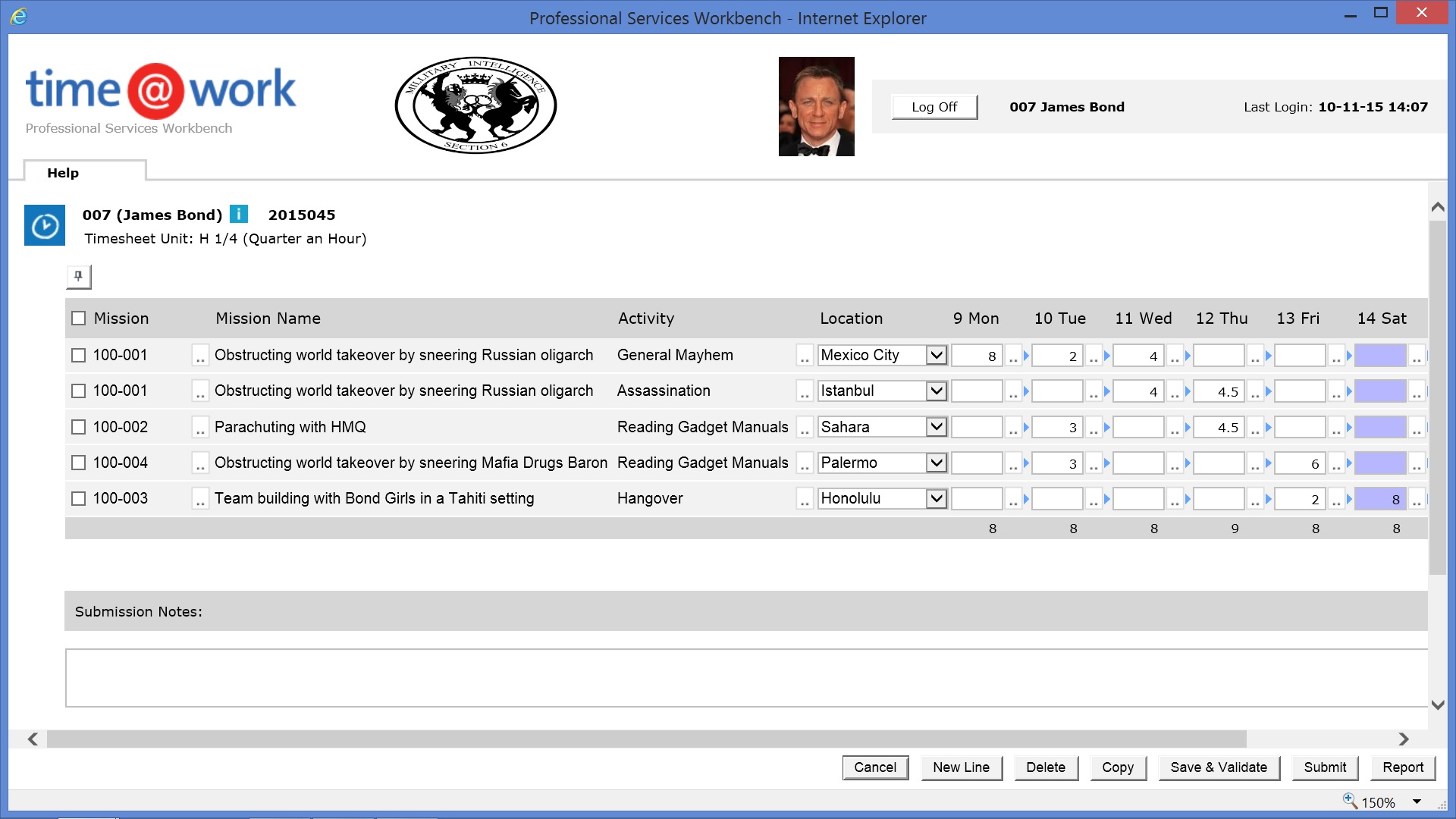
(We see Bond confirming his timesheet (see below for suggested content) and then, if he’s quick enough, his expenses, too. Music starts and film ends.)

==

Barbara, I’d be happy to offer a barter deal if you feel a large payment isn’t possible. I feel sure that timesheets and expenses could be of great benefit to your production staff and cast during the making of the next Bond film, and, if it would help, we can throw in free training for the stars.

With best wishes,

Adam Bager – Chairman, systems@work

==

Sadly, I never got a reply from Barbara, but I’ll write again for the next film. With good racy dialogue, such as the above, time@work could seem just as alluring and essential as an Aston Martin, a Sony mobile or an Omega watch.

Bond’s Busy Week

Timesheet 007

Take a Note, Miss Weaver

Miss Moneypenny tells us a lot about how the world has changed.

In all but the most recent James Bond film she’s a demure, adoring, secretary who knows her place – on the shelf and behind a desk.

moneypenny1

But in the latest Bond film, Skyfall, she’s as swashbuckling as Bond, engaged in the same acrobatic, dare-devil feats. You’ll remember her as the markswoman who nearly shoots both Bond and the villain as they grapple on the top of a train that’s swooshing across a viaduct.

The joke comes in the final minutes of the film when we learn that she’s Miss Moneypenny. It’s during one of those debriefing scenes in Whitehall, and we see her, newly retired from the action-heroine stuff, as an important woman behind a desk, definitely nowhere near the shelf, and with no conspicuous adoration for James.

And let’s not forget that C is a woman too (how we will miss Judi Dench).

moneypenny2

Times have changed. We live in a more gender-equal world, and many of the things that women were assigned, largely by men, to do, we now do ourselves, man or woman. The ‘typing pool’ has long been drained.

In fact, I think I’ve never said, ‘Take a note, Miss Weaver’, or ‘Get me so and so.’ I do all my own emails, I dial all my own calls, and I always have (very nearly). I do most of my own hotel and travel reservations, too.

(Though, quickly to forestall an accusation of hypocrisy, I must admit that Darina and Kamila do make a lovely cup of tea.)

No one just types, dials and photocopies anymore. No longer are shorthand and typing both essential and sufficient qualifications for any young woman or man. The windows of ‘temp’ agencies rarely refer to ’50 wpm (words per minute)’ as a qualification. We do things ourselves nowadays and the world is a better place for it.

But one word of advice: learn to type properly, whoever you are and whatever you are..

In 1980 I set myself the task of learning touch-typing, using an old-fashioned portable typewriter and a book that took me through the intricate motions, lesson by lesson. It was one of the most useful things I ever did. Far more useful than a degree in Philosophy. And though I don’t quite touch-type nowadays (all sorts of lazy habits have crept into my technique) I’m grateful that I can still type rapidly. Perhaps even 50 wpm, with lots of corrections.

Typing is an essential skill, whether you’re Miss, Ms, Madam, Master, or Mister Weaver.