Strange Sounds

If, after a nuclear disaster or catastrophic meteor strike, there survived only four superb classical instrumentalists – an oboist, a clarinettist, a basset horn player and a bassoonist – and little sheet music other than an arrangement for these four of Bach’s Goldberg Variations, then I might perhaps be willing to listen to them play it. Otherwise, not.
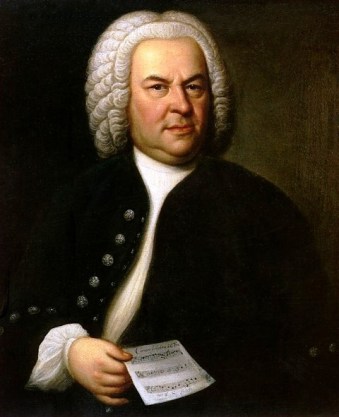
Johann_Sebastian_Bach

I attended the world premiere of an arrangement of the Goldberg for these four instruments last night in Prague, played with astonishing precision, verve, mischief and technical brilliance by four Czech musicians, two of whom I knew well from the classical music competition my company, LLP Group, sponsored more than a decade ago, and one of whom, the bassoonist Vaclav Vonasek, will shortly join the Berlin Philharmonic (see Two Musicians to be Proud Of). Vaclav was the brilliant culprit behind this eccentric arrangement (and, he assured me, he left out none of the notes).

Now, I am not especially conservative or pedantic when it comes to authenticity and performance. Rearrangements for instruments and voices other than those for which a piece of music was written can be illuminating. I sometimes even enjoy shifts of genre (I’m all for diversity) and the music of Bach is generally more amenable than most to various forms of reengineering. There is something to be enjoyed even in the ghastly jazz versions by the Jacques Loussier trio (listen to their ‘Play Bach’ Goldberg Variations here (no, actually, on second thoughts this is quite astonishingly repugnant)). Unusual contexts (railway stations, shopping malls, swimming pools) can bring something new to our understanding of music.

I have around six different recordings of the Goldberg Variations (I know people with many more), including one of  an arrangement for string orchestra, and both of the Glenn Gould versions. I enjoy them all and am not quite sure why I choose one on one day and another on another. So I was intrigued when Vaclav announced his ‘experiment’ and was sorry to enjoy it only in so far as I could force myself whilst listening to imagine it played on a keyboard instrument.

The problem lay in the fact that the different sounds and styles of these four instruments suggested that the variations are a conversation carried on between them, as if there are up to four quite separate musical lines in the music, which, I think, there are not. It might have worked better on four more similar instruments, four saxophones, or four stringed instruments. Whilst Bach’s Art of Fugue is amenable to such treatment, indeed requires it, the Goldberg Variations is more of a monologue than a conversation. Vaclav admitted as much when suggested to me afterwards that it should somehow be experienced in mono rather than stereo. Unfortunately I don’t have mono ears, even though I have always had difficulty in hearing stereo.
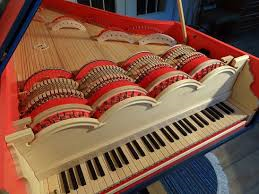
viola organista

By chance I was also listening yesterday to another strange instrument, the viola organista, designed by Leonardo da Vinci in the 15th century. It never caught on in a big way, but one of the ‘Poles of the worst sort’ whom I met last week in Warsaw kindly gave me a recording of arrangements and original music written for the instrument. From a distance it looks like a harpsichord but it’s actually a very sophisticated kind of hurdy-gurdy. Rotating wheels, powered by a pedal, ‘scrape’ strings that are raised or lowered by the keys of a keyboard, just as a bow plays the strings of a viola, though I suppose in this case it’s the strings that are moving up and down. Vibrato and dynamics can be controlled by touch, but the varieties of tone and attack are limited. The result is a pleasant sound that’s a blend of organ and string orchestra, and quite unique. Certainly worth listening to. I look forward to hearing the Goldberg Variations on the viola organista.

Hear Slawomir Zubrzycki play one that he constructed himself.

‘Poles of the Worst Sort’

warsaw

I dined and lunched in Warsaw with Poles of the worst sort on Thursday and Friday, or, rather, ‘Poles of the worst sort’, the description recently used by Poland’s Jarosław Kaczyński, leader of the right-wing Law and Justice Party, to describe all opponents of his party. These Poles of the worst sort have been my friends for between ten and twenty years, and I have never known them more anxious about their country than now. They are cultivated, intelligent, successful, secular, liberal friends who have enjoyed and been proud of the Poland that emerged from Communism in 1989. Two of them find themselves, for the first time in decades, marching again for a political cause, their freedom.

The Law and Justice Party, led by Jarosław Kaczyński, but represented in Government by Prime Minister, Beata Szydło, now rules Poland. It had never before commanded a majority in the Sejm, but since winning power with an absolute majority, last year, the Government has set about building the kind of ‘illiberal democracy’ promoted by Viktor Orban, Prime Minister of Hungary. Together with Hungary, and perhaps Slovakia, Poland might yet form an axis of right-wing intolerant nationalism radically at odds with the founding liberal values of the European Union. Only the Czech Republic, one of the most secular nations in Europe, adheres still to the liberal values it embraced after the fall of Communism.

The Polish Government has moved so fast and so far in an illiberal direction that, following attempts to challenge the independence of the civil service, place the public media under Government control and attack the constitutional court, the European Union has begun to probe its undermining of democracy. What the EU might eventually do about it is questionable. There is no realistic option that sanctions might ever be applicable.

Poland’s economy is the 23rd largest in the world, and its estimated GDP per capita (at purchasing power parity) of 27,654 USD places it 49th in the global rankings. The country was one of the few to continue growing during the recent financial crisis.

Poland has been conspicuously successful. My visit to Warsaw last week was my first for three years, and I was astonished by how the city has changed, even over such a short time, the centre now bristling with impressive high-rise offices. There is a feeling of power, prosperity and confidence to the city. The previous Government had not been notably incompetent.

Why, then, has the country lurched to the right?

It might be yet another case of popular frustration with the political establishment. Clandestine recordings of conversations at a restaurant frequented by ministers of the last Government apparently revealed a cynical contempt for the electorate amongst the ruling classes. This might have been a factor. My friends suggest that it is the young who have elected the new Government, and who most ardently support it, apparently attracted by its blunt, uncompromisingly Catholic, and occasionally xenophobic, attitudes.

Poland’s Foreign Minister, Witold Waszczykowski, has worried about “a new mixing of cultures and races, a world made up of bicyclists and vegetarians, who … fight all forms of religion.”

This is unpleasant rhetoric, nationalist, and socially illiberal. It is ironic that the Government has criticised recent German commentary as Nazi in tone, when their own language hints at racism and the intolerance of minorities of all kinds. But even the Catholic Church, a keen supporter of the Law and Justice Party, offers no particular views on vegetarianism and bicycling.

Where, I wonder, would the Polish Government stand on such issues as gay marriage, asylum seekers, and abortion? I asked my friends when we might see legislation passed in Poland to allow gay marriage. Their incredulous laughter was answer enough.

Read more in this excellent commentary from the New York Review of Books.