
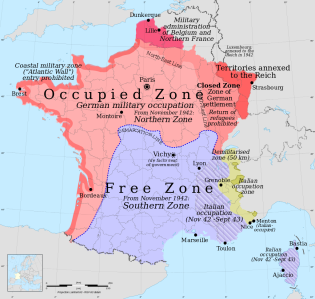
I’ve just got to the end of Allan Massie’s wonderfully readable series of four crime novels, all set in German-occupied Bordeaux between 1940 and 1944. They’re a very palatable kind of history lesson, and as gripping and complex as any crime fiction must also be. Crime, though, is merely incidental to them. Above all they’re an exploration of the moral complexities of compromise, the public compromise with Hitler’s Germany of both the Occupied Zone and the Free Zone of Vichy France, and the private compromise that each character must make in leading his or her professional or private life.
It’s impossible to imagine equivalent novels set in the morally less complex and undivided Britain of the same period, at least once the temptations of appeasement were put aside. The choice was simple: ‘We shall fight on the beaches, we shall fight on the landing grounds, we shall fight in the fields and in the streets‘ and so on. To all intents and purposes, after May 1940, everyone in Britain was on the same side.
France was different. Vichy France was a chance for reactionary forces, unhappy with Republican France, to remake at least part of the country as an authoritarian Catholic nation. And for the Communists the Resistance was an obvious breeding ground. As history, these novels reveal an extremist passion in French politics that was and is (agreeably) absent from British political life, where in the twentieth century there hasn’t been any real danger of dictatorship, neither of the right, nor of the left.
Many of Massie’s characters choose the Right and join the milice to fight the Resistance, or the Volunteer Legion against Bolshevism to fight with Hitler’s armies on the Eastern Front. Others choose the Left, joining the communists who made up a large part of the Resistance, and who were only just outmanoeuvred by De Gaulle after the liberation of France in 1944. Both commit ideologically motivated crimes of great cruelty and ruthlessness against their fellow Frenchmen and women, both during the War, and in acts of retribution, after the liberation of 1944. French society had and has more cause for division than British society ever had.
The Right and Left live on in France, as we have seen this weekend, with the National Front more successful in regional elections than anyone could have expected. Marie Le Pen stands far further to the right than the UK’s Nigel Farage, and represents a brand of intolerance that wouldn’t, I think, catch on in the UK.
Allan Massie’s four novels are peopled with a well-imagined cast of selfish aristocrats, Germans (some of them good and honourable ones), reactionaries, Jews, communists, gays, spies, prostitutes, collaborators or many kinds, and policemen, most notably Inspector Lannes, the troubled mid-ranking investigator who, together with his ideologically divided children, is at the centre of events.
I’ve always been fond of Allan Massie’s writing, not least because he favourably reviewed the acting of an old friend of mine who appeared at the Edinburgh Festival in the late 1970s, and never, as it happens, on the stage again. All of Massie’s novels are instructive, thoughtful, lively, and readable in a good old-fashioned way. There’s nothing alarming or experimental about his technique to deter you, and although he’s a Scottish unionist Tory, he’s clearly a conservative with a socially liberal conscience. His novels are ‘moral’ novels, exploring the complexities of human loyalty, both public and private, and all varieties of human need. I began with his accounts of the lives of the early Roman Emperors, and continued with his three twinkly and mischievous novels set in the Dark Ages. Read them all. They are effortlessly enjoyable but never trivial.
 Adam Bager