The Turning World

There’s a story that goes around Central Europe about a man called Pavel, or Pal, or Paul, who was born in Austro-Hungary, grew up in Romania, lived briefly in Ruthenia, and Hungary, worked in the Soviet Union and died in Ukraine. All without ever leaving his tiny village in Sub-Carpathian Ruthenia. Given the monstrous behaviour of those who trample across remote corners of the world, he must have been a master of tact to have survived at all. He probably spoke at least a dozen languages fluently.

It’s an unfamiliar concept for a British Citizen, that our nationality and allegiances might change around us, but we may soon, if Scotland achieves independence, have to accept a change of citizenship (United Kingdom of England, Wales and Northern Ireland).

I thought of Pavel, Pal or Paul yesterday whilst in the Serbian city of Subotica, just across the border from Szeged. It’s a town that’s been stamped a dozen or more times into my passport, since it lies on the rail and road routes from Budapest to Belgrade. It’s actually a charming small city, replete with the usual fin-de-siècle art nouveau town hall, banks, shops, churches and synagogues (no mosques, as far as I know).

It’s a town that has endured many ‘affiliations’, to use a term that Wikipedia uses, most of them probably not affiliated by choice.

subotica

Terrible atrocities have been committed in the city, by one ethnic group against another, whilst enforcing one affiliation or another, not least by the Nazis and their henchmen against the city’s 3,000 Jews, transported and murdered in Auschwitz.

I stopped to eat two slices of pizza, four cups of tea and a plate of tiramisu (all quite permissible when one is cycling nearly 100 km a day), and since I like to practice my imperfect Hungarian I asked the waiter if he spoke the language. He did, he said, since one of his parents is ‘Hungarian’ and the other ‘Serbian’.  I made a half-hearted attempt to order ‘hot black tea with cold milk on the side’ in Hungarian, but he greatly preferred to practice his excellent English, which, in any case, put my poor Hungarian to shame. But since it’s a fashionable concept I asked him how he ‘identified’.

‘I am a Vojvodinian,’ he said.

If you’re not aware that Vojvodina is a place, you might think this as absurd as identifying as a Vulcan (which certain people do (and who are we to judge?)).

But in fact it’s a clever ruse, and the best possible answer if you come from a place that everyone else has trampled over. Vojvodina is an identifiable region but, sadly (or wisely?) never one that was affiliated only to itself.
 

Borders – Back Where We Were?

Over the next three days we’re holding our company-wide LLP Group ‘consulting’ weekend in Visegrad in Hungary, in a spa hotel overlooking the Danube, just where the river bends down towards Budapest from the Slovak border. We have these conferences once a year. They’re expensive in terms of direct costs and opportunity costs, but they’re educational and they’re good for morale. The drinks are on us.

My colleagues are coming from the Czech Republic, Slovakia, Russia, Bulgaria, Romania and Luxembourg. Those travelling far are flying, but most of us are travelling by car, crossing as many borders as we must. Four of us made the journey yesterday, and it took eight hours to get from Prague to Visegrad. Two hours too many, but not, in fact, because borders have become more difficult, but because of a minor accident involving some trucks and a huge traffic jam. In 23 years of travelling on the dreadful Prague to Bratislava highway I can remember only a few occasions when the road was clear from one end to the other.

rajka

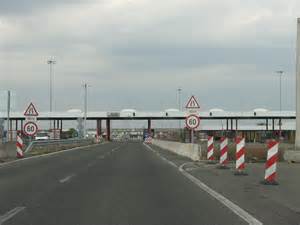
We were apprehensive that the closing of some Schengen borders in response to the refugee crisis might delay our journey, but we crossed the border between Slovakia and Hungary without delay. Only the long queue of cars and trucks crossing from Slovakia to Austria was a reminder of the reversion to the old restrictions on travel.

It’s depressing that after so many years of free movement borders are being closed in Europe. That we have taken open borders for granted for years now has never been more clear than during these temporary inconveniences. Perhaps we’ve already seen Europe at its most open, and won’t be criss-crossing as easily again for a lifetime or two.

A Belorussian colleague dared not travel at all, since his passport is currently with the British Consular authorities in Warsaw awaiting the granting of a British visa. These were the kind of inconveniences I thought we’d long ago put to rest.

The real border, of course, is the Schengen one, and the worst border is the one between Serbia and Hungary. Refugees/migrants are massing in ever greater numbers and trouble is inevitable. Indeed, yesterday there was tear gas. Let’s hope that tomorrow there aren’t bullets.

I sympathise with Hungary. Perhaps no one at the EU’s top tables took the problem seriously enough when there was time to do something about it – properly to finance and accommodate an orderly and humane acceptance of migrants arriving at the borders, and to ease their travel to safe havens all over Europe.

But Hungary’s policy of prevention, will surely not work, neither for Hungary in the long term, nor for the EU.

All You Need

biking stuff

You don’t need much for eight days’ cycling around the edge of Hungary. I’ve been known to go on trips where your luggage is carried from hotel to hotel, whilst you cycle at a leisurely pace, unencumbered by clothes and equipment, but those trips are for softies. Serious cycling is a penitential experience, and you must fend for yourself, comfort generally shunned. That said, I confess that don’t carry a tent, nor cooking equipment and I do stay in hotels and eat in restaurants, when I can find them.

So, what does a moderately penitential cyclist carry? What you see in the picture is what I took.

Devices

  • 1 Dell Notebook PC and cable
  • 1 Kindle and cable
  • 1 iPhone and cable (iPhone not in the pic, since in use)

Bike Wear

  • Three light luridly-coloured easy-to-wash easy-to-see miracle-fibre tops
  • Two light easy-to-wash miracle-fibre shorts
  • Helmet (including net to prevent insects reaching hair)
  • Waterproof jacket from sponsor Helly Hansen

Elegant Evening Wear

  • Three pairs black socks
  • Three polo tops from sponsor Banana Republic
  • Hoody for chilly evenings

Constant Wear

  • Rigidly-soled cycling sandals
  • Underwear (five pairs)

Food and Drink

  • Small bag of nuts
  • 40 Gold Blend teabags from sponsor Marks & Spencer

Bathroom and Medical Supplies

  • Savlon for abrasions and mosquito bites
  • Toothpaste from sponsor Colgate
  • Deodorant from sponsor Gillette
  • Toothbrush
  • Painkillers for headaches caused by dehydration and drink
  • Blood pressure pills to alleviate the high blood pressure brought on by age and an unhealthy lifestyle
  • Razor from sponsor Gillette
  • 50+ Sun Cream
  • Black Pepper Cologne by sponsor Molton Brown
  • Bag to put them all in

Miscellaneous

  • Glasses and case
  • Cash
  • Passport
  • Credit Cards
  • Bag to put them in from sponsor Etihad
  • Pens from sponsor British Airways
  • Earphones
  • Two maps

That’s all. Try it. Who needs furniture and paintings and things? Life can be simple and free.

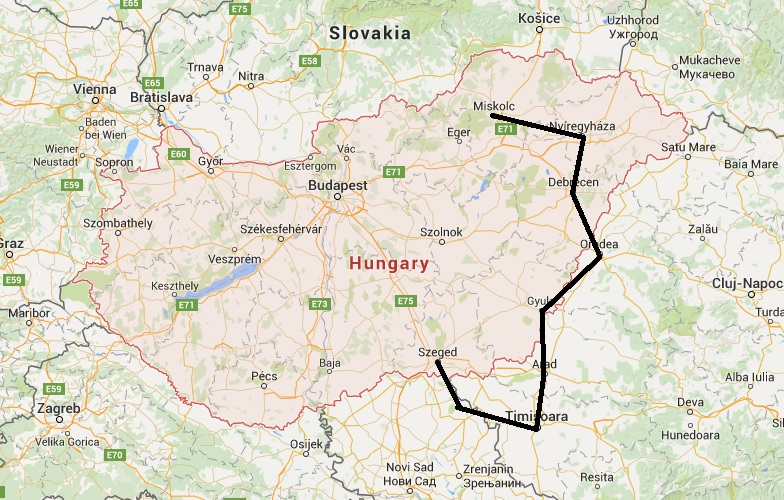
But I’m off my bike now. I’d go further, much further (‘second star to the right and straight on ’til morning’), but having arrived in Timisoara two days ahead of schedule, I added on Szeged, reached in two days through a corner of Serbia, and there, after 675 km, I stopped and got on a train.

bike map