The Art of Consulting – Designing (Completeness & Simplicity)

Share

There comes a moment, after all the reading, listening, questioning, analysing, presenting and writing, when you’ve finally got to come up with an idea. You can’t defer it indefinitely.

Whether you’re a lawyer devising an argument, a systems analyst designing software, an architect designing a house, an engineer constructing a bridge, a general planning an attack, or a marketing consultant devising a campaign, there’s only so long you can ignore that look in the client’s eye that says, ‘So….what should we do?’

Imagination is involved at all stages of the consulting process, but so far it’s played a relatively minor role. There’s imagination involved in ferreting out the facts, for example, but it’s needed most of all at the point where you must devise a solution, though it’s also tempered by experience and wisdom. Sadly, solutions can’t simply be logically derived from the facts in front of you. If you’ve structured your findings well, you’ve probably already worked your way towards the answer. But you need inspiration to get you there.

However, inspiration, like the poet’s Muse, isn’t always at your beck and call. Each of us has a different way of invoking it. Some get drunk, some sleep on it, sometimes even dreaming a solution (just as Wagner dreamt the opening bars of Das Rheingold whilst dozing before the fire), some play rugby or squash, some play chamber music. Sherlock Holmes played the violin and injected himself with something special. We all have our own way, legal or otherwise. I like to put things aside for a while and let the facts tumble about in my mental washing-machine until, at an unexpected moment, they seem to sort themselves out into an idea. But however they come, they don’t come through a logical progression of the facts.

Scientific theory is the same. The experimental evidence is laid out before the scientist, who has to sweep it all up into one grand theory that accommodates it all. Or more than one theory. Half the problem with solutions and theories is deciding which one is the right one.

A solution must solve the problem, a scientific theory must fit the facts (and predict a few more facts so that it can move forward through failure). But often there are many theories that fit the facts, and many solutions that solve the problem. Does the earth rotate around the sun, or the sun around the earth? Rival theories can be made to fit the facts, almost indefinitely, but the strain begins to show when one theory becomes more complex as the other one remains simple. We reject complexity where simplicity will do. (Conspiracy theorists habitually break this rule.)

And that’s where other principles play a part. Completeness may be the first principle of good design (your solution or theory must explain (or rationally discard) your findings) but the second principle of good design is simplicity.

Ockham

Simplicity may seem like an obvious principle that doesn’t need writing down, but it’s first expression is credited to William of Ockham (1238-1348). His ‘law of parsimony’, often known as Occam’s Razor, cuts out the unnecessary entities in a theory. He framed his  lex parsimoniae in Latin – entia non sunt multiplicanda praeter necessitate which is roughly translated as ‘entities must not be multiplied beyond necessity’. There’s an alternative version Pluralitas non est ponenda sine necessitate which is translated  as ‘plurality should not be posited without necessity’. Both can be paraphrased as ‘All other things being equal, the simplest solution is the best.’

Ockham was an English Franciscan friar and he lived before the scientific age, but his principle of simplicity applies to theory even if there aren’t any ‘facts’. He applied his law to the make-believe world of medieval theology. Try counting entities you can’t actually see. But what the law doesn’t tell you is exactly how to recognise simplicity. It isn’t always obvious. Must you count the ‘entities’ or is your judgement aesthetic? I suspect it’s a bit of both.

How would you design a device for removing the peel from potatoes (otherwise known as a potato peeler!)?

Like this?
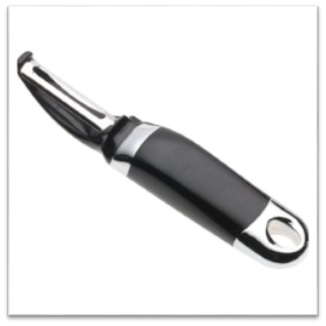
peeler 1

Or like this?

peeler 2

William Heath Robinson was famous for designing unnecessarily complicated machines. There’s a simple and serious point to his drawings. Though there’s a certain joy in ingenuity and complexity, it’s best never to make things more complicated than they need to be.

So, what is good design?

Good design is:

  • Complete
  • Simple

But it’s also:

  • Practical
  • Affordable
  • Flexible
  • Maintainable
  • Elegant

We will look at these additional principles in a later post.

See also:

The Art of Consulting

The Art of Consulting – What’s the Role of the Consultant?

The Art of Consulting – Impartial, Honest and Independent

The Art of Consulting – The Essential Skills

The Art of Consulting – Listening

The Art of Consulting – What’s a Good Question?

The Art of Consulting – Representation and Analysis

The Art of Consulting – Writing Simply

The Art of Consulting – Writing Simply

Share

Consultants of any kind must be able to write well, to document facts clearly, and convey ideas and plans succinctly, unambiguously and persuasively. In my view, except when specific technical terms must be used, everything that can usefully be said can be said using simple language.

graham greene pic

Graham Greene – one of my literary heroes

—What’s the best prose style for a consultant (assuming that we needn’t consider poetry)? It should:

  • —Be logically clear
  • —Use everyday vocabulary
  • —Consist of short sentences
  • —Avoid exaggeration
  • Be persuasive but not emotional
  • —Be direct and explicit (avoiding hints, suggestion, implication, and ambiguity)
  • Be as brief as possible
  • Be complete and coherent
  • —Avoid cliché
  • —Avoid jargon
  • —Not use unexplained acronyms
  • Use humour carefully
  • Avoid repetition and redundancy, except in an explicit summary

That said, I do like stylish writing from time to time, I just don’t think it’s how a consultant should write in his or her professional role. Take this excerpt from Henry James’ The Ambassadors (1903):

Strether’s first question, when he reached the hotel, was about his friend; yet on his learning that Waymarsh was apparently not to arrive until evening he was not wholly disconcerted. A telegram from him bespeaking a room ‘only if not noisy’, reply paid, was produced for the enquirer at the office, so that the understanding they should meet at Chester rather than at Liverpool remained to that extent sound.

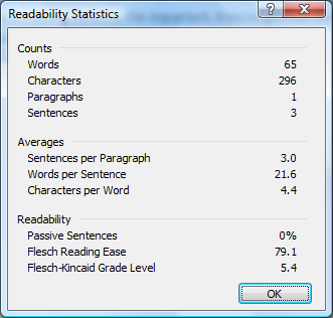
It is wonderfully elliptic, its rambling structure conveying Strether’s hesitant and uncertain thinking, but, if you go by Microsoft Word’s measure of readability (see below) this kind of prose requires a relatively high level of education (not to mention patience).

Henry Janes

In contrast, here’s a much easier excerpt from Graham Greene’s Brighton Rock (1938):

It was a fine day for the races. People poured into Brighton by the first train; it was like Bank Holiday all over again, except that these people didn’t spend their money; they harboured it. They stood packed deep on the tops of the trams rocking down to the Aquarium, they surged like some natural and irrational migration of insects up and down the front.

Microsoft Word calculates readability as:

Graham Greene

We can probably assume that most consultants and their clients have completed secondary education, so both passages should make sense to them, but simplicity is always better if it can be achieved.

Here’s my rewriting of Henry James’ text in the style of Graham Greene, just for the fun of it:

When he reached the hotel, Strether asked about his friend, Waymarsh. The clerk told him that Waymarsh would not arrive until the evening. Strether was not worried. The clerk showed him Waymarsh’s reply-paid telegram asking for a quiet room. Waymarsh knew then that they would definitely meet here in Chester rather than in Liverpool.

More digestible, even if the information is the same, but less ‘stylish’.

One more point about style: though many conservative writers of prose don’t like contractions such as don’t for do not (notably Michael Gove, the UK’s Minister of Justice, who circulated a memo on prose style to his department a few days ago), I favour prose that sounds like speech. So I would go a little further with the Graham Greene rewriting of Henry James:

When he reached the hotel, Strether asked about his friend, Waymarsh. The clerk told him that Waymarsh wouldn’t arrive until the evening. Strether wasn’t worried. The clerk showed him Waymarsh’s reply-paid telegram asking for a quiet room. Waymarsh knew then that they would definitely meet here in Chester rather than in Liverpool.

(You might have noticed that Graham Greene uses one contraction in the excerpt from Brighton Rock.)

In our ‘professional’ prose, we should avoid:

  • Long sentences
  • Difficult words when simple words would do
  • Passive constructions
  • Double negatives

Unfortunately, this is the sort of rubbish that some consultants write:

The fundamental and underlying issue we have, as of now, in respect of teaming up the system selection group, is this: the human resources currently involved in preparation for the project have already expressed a preference for their system of choice, even before project initiation. This system doesn’t reflect the input to the choice process from the logistics department, who have not, as of now, been contributive.

Sins include:

  • Repetition (fundamental and underlying)
  • Redundancy (as of now, currently)
  • Lazy neologisms (teaming up, choice process, contributive)
  • Cliches (human resources (when people would do), system of choice)

This ‘rubbish’ is a deliberate exaggeration, concocted by me, but some consultants do write in this way. Why not put it all more simply?

We must include the logistics department in the system selection team.

We mustn’t think that we’re paid by the sheer quantity of words we write for our clients.

Here are some more rules:

  • —If a paragraph can be removed without loss of meaning, remove it.
  • —If a sentence can be removed without loss of meaning, remove it.
  • If a word can be removed without loss of meaning, remove it.
  • No need for a literary style
  • No need for poetry

Or, putting it another way (taking my own medicine):

  • —If a paragraph, sentence, or word can be removed without loss of meaning, remove it.

Or why not…

  • —If something can be removed without loss, remove it.

To use a horrible cliché – LESS IS MORE!

See also:

The Art of Consulting

The Art of Consulting – What’s the Role of the Consultant?

The Art of Consulting – Impartial, Honest and Independent

The Art of Consulting – The Essential Skills

The Art of Consulting – Listening

The Art of Consulting – What’s a Good Question?

The Art of Consulting – Representation and Analysis