The Art of Consulting – Designing (Pragmatism)

Share

You can design the most beautiful building in the world but it’s no good if it’s too difficult to build. Think of the Sydney Opera House. It was imaginatively and brilliantly conceived with little regard for how it might be built, and the final cost of construction was astronomically higher than the original budget allowed.

You can design a software system that reflects a set of business requirements completely, and as simply as logic permits, but it’s no good if you need a doctorate in mathematical logic to use it.

Perhaps you can even build a sophisticated legal argument too brilliant for a jury to grasp. And I’m sure a surgeon can design a surgical procedure that’s far too difficult for most surgeons to execute.

Theory can enable you to design something as perfect and as simple as it might possibly be, but only experience can tell you whether you need to simplify still further to make it usable. Consulting is an art, and although the best artists are often young iconoclasts with the most up-to-date knowledge of technology, consultants generally get better with experience, and it’s often the grey-haired veterans who are the best at designing something workable. They’ve come to know what is possible in the real world.

I remember the frightening years of the Dot.Com boom when those of us who possessed even a few grey hairs were thought of as past it. The IT world suddenly belonged to the young dotcommers who thought up brilliant things that our minds, dulled by too much experience, were incapable of. If you were over thirty, you probably couldn’t raise a penny in investment capital.

One of these brilliant things was a website called boo.com which was designed to sell clothes through the internet and which would be driven by software so brilliant that users would see what clothes might look like on their own bodies by entering their vital statistics and then rotating a graphical ‘model’. It doesn’t sound so difficult now, but back then, more than fifteen years ago, it was impossible. Bandwidth wouldn’t allow it and there wasn’t enough time to write good enough software. Boo.com got through its 135 million dollars of venture capital and failed spectacularly. The real world wasn’t good enough for the entrepreneurs’ ideas.  Read about it in BooHoo.

Of all my own failings as a systems design consultant none is worse than my always attempting to build something that can do everything a client wants or needs. I’ve probably got wiser over the years, but I still try too hard to design some logic for every eventuality. It’s not that the logic I design isn’t right, but rather it’s sometimes too complex. It’s a general rule that as the logic of systems becomes more complicated, so the users’ understanding of it becomes weaker.

When something is more complicated there is not only more of it that can go wrong (software is never perfect) but more importantly, more user mistakes can be made with it, and such mistakes get ever harder to correct. Given that a consultant must eventually do a disappearing act, it’s better to leave a client with something simple and manageable.

Along with this wisdom of experience comes the skill of convincing a client that ‘keep it simple’ is a good guiding principle and that although you CAN do what the client wants, it wouldn’t be wise.

Think also of the Kalashnikov rifle – simple and pragmatic. In a life or death moment you want something that can’t go wrong in too many ways.

Kalashnikov

In the film, Lord of War, arms dealer Yuri Orlov comments:

Of all the weapons in the vast Soviet arsenal, nothing was more profitable than Avtomat Kalashnikova…. more commonly known as the AK-47, or Kalashnikov. It’s the world’s most popular assault rifle, a weapon all fighters love. An elegantly simple, 9 pound amalgamation of forged steel and plywood. It doesn’t break, jam, or overheat. It’ll shoot whether it’s covered in mud or filled with sand. It’s so easy, even a child can use it – and they do.

So, one of the secrets of good design is to design something that can actually work, can actually be used. Don’t let theoretical fancy lead you into the realms of the impossible, however complete, however beautiful your idea.

See also:

The Art of Consulting

The Art of Consulting – What’s the Role of the Consultant?

The Art of Consulting – Impartial, Honest and Independent

The Art of Consulting – The Essential Skills

The Art of Consulting – Listening

The Art of Consulting – What’s a Good Question?

The Art of Consulting – Representation and Analysis

The Art of Consulting – Writing Simply

The Art of Consulting – Designing (Completeness & Simplicity)

The Art of Consulting – Designing (Completeness & Simplicity)
Share

There comes a moment, after all the reading, listening, questioning, analysing, presenting and writing, when you’ve finally got to come up with an idea. You can’t defer it indefinitely.

Whether you’re a lawyer devising an argument, a systems analyst designing software, an architect designing a house, an engineer constructing a bridge, a general planning an attack, or a marketing consultant devising a campaign, there’s only so long you can ignore that look in the client’s eye that says, ‘So….what should we do?’

Imagination is involved at all stages of the consulting process, but so far it’s played a relatively minor role. There’s imagination involved in ferreting out the facts, for example, but it’s needed most of all at the point where you must devise a solution, though it’s also tempered by experience and wisdom. Sadly, solutions can’t simply be logically derived from the facts in front of you. If you’ve structured your findings well, you’ve probably already worked your way towards the answer. But you need inspiration to get you there.

However, inspiration, like the poet’s Muse, isn’t always at your beck and call. Each of us has a different way of invoking it. Some get drunk, some sleep on it, sometimes even dreaming a solution (just as Wagner dreamt the opening bars of Das Rheingold whilst dozing before the fire), some play rugby or squash, some play chamber music. Sherlock Holmes played the violin and injected himself with something special. We all have our own way, legal or otherwise. I like to put things aside for a while and let the facts tumble about in my mental washing-machine until, at an unexpected moment, they seem to sort themselves out into an idea. But however they come, they don’t come through a logical progression of the facts.

Scientific theory is the same. The experimental evidence is laid out before the scientist, who has to sweep it all up into one grand theory that accommodates it all. Or more than one theory. Half the problem with solutions and theories is deciding which one is the right one.

A solution must solve the problem, a scientific theory must fit the facts (and predict a few more facts so that it can move forward through failure). But often there are many theories that fit the facts, and many solutions that solve the problem. Does the earth rotate around the sun, or the sun around the earth? Rival theories can be made to fit the facts, almost indefinitely, but the strain begins to show when one theory becomes more complex as the other one remains simple. We reject complexity where simplicity will do. (Conspiracy theorists habitually break this rule.)

And that’s where other principles play a part. Completeness may be the first principle of good design (your solution or theory must explain (or rationally discard) your findings) but the second principle of good design is simplicity.

Ockham

Simplicity may seem like an obvious principle that doesn’t need writing down, but it’s first expression is credited to William of Ockham (1238-1348). His ‘law of parsimony’, often known as Occam’s Razor, cuts out the unnecessary entities in a theory. He framed his  lex parsimoniae in Latin – entia non sunt multiplicanda praeter necessitate which is roughly translated as ‘entities must not be multiplied beyond necessity’. There’s an alternative version Pluralitas non est ponenda sine necessitate which is translated  as ‘plurality should not be posited without necessity’. Both can be paraphrased as ‘All other things being equal, the simplest solution is the best.’

Ockham was an English Franciscan friar and he lived before the scientific age, but his principle of simplicity applies to theory even if there aren’t any ‘facts’. He applied his law to the make-believe world of medieval theology. Try counting entities you can’t actually see. But what the law doesn’t tell you is exactly how to recognise simplicity. It isn’t always obvious. Must you count the ‘entities’ or is your judgement aesthetic? I suspect it’s a bit of both.

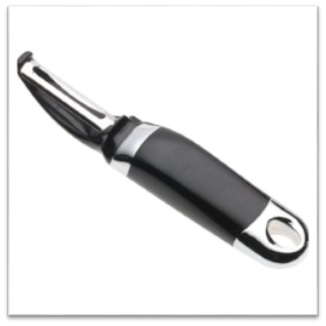
How would you design a device for removing the peel from potatoes (otherwise known as a potato peeler!)?

Like this?

peeler 1

Or like this?

peeler 2

William Heath Robinson was famous for designing unnecessarily complicated machines. There’s a simple and serious point to his drawings. Though there’s a certain joy in ingenuity and complexity, it’s best never to make things more complicated than they need to be.

So, what is good design?

Good design is:

  • Complete
  • Simple

But it’s also:

  • Practical
  • Affordable
  • Flexible
  • Maintainable
  • Elegant

We will look at these additional principles in a later post.

See also:

The Art of Consulting

The Art of Consulting – What’s the Role of the Consultant?

The Art of Consulting – Impartial, Honest and Independent

The Art of Consulting – The Essential Skills

The Art of Consulting – Listening

The Art of Consulting – What’s a Good Question?

The Art of Consulting – Representation and Analysis

The Art of Consulting – Writing Simply

The Art of Consulting – Writing Simply

Share

Consultants of any kind must be able to write well, to document facts clearly, and convey ideas and plans succinctly, unambiguously and persuasively. In my view, except when specific technical terms must be used, everything that can usefully be said can be said using simple language.

graham greene pic

Graham Greene – one of my literary heroes

—What’s the best prose style for a consultant (assuming that we needn’t consider poetry)? It should:

  • —Be logically clear
  • —Use everyday vocabulary
  • —Consist of short sentences
  • —Avoid exaggeration
  • Be persuasive but not emotional
  • —Be direct and explicit (avoiding hints, suggestion, implication, and ambiguity)
  • Be as brief as possible
  • Be complete and coherent
  • —Avoid cliché
  • —Avoid jargon
  • —Not use unexplained acronyms
  • Use humour carefully
  • Avoid repetition and redundancy, except in an explicit summary

That said, I do like stylish writing from time to time, I just don’t think it’s how a consultant should write in his or her professional role. Take this excerpt from Henry James’ The Ambassadors (1903):

Strether’s first question, when he reached the hotel, was about his friend; yet on his learning that Waymarsh was apparently not to arrive until evening he was not wholly disconcerted. A telegram from him bespeaking a room ‘only if not noisy’, reply paid, was produced for the enquirer at the office, so that the understanding they should meet at Chester rather than at Liverpool remained to that extent sound.

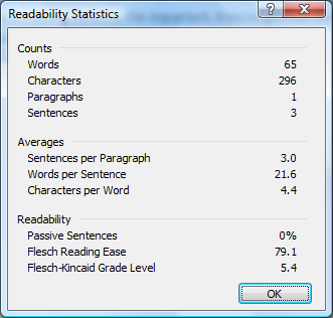
It is wonderfully elliptic, its rambling structure conveying Strether’s hesitant and uncertain thinking, but, if you go by Microsoft Word’s measure of readability (see below) this kind of prose requires a relatively high level of education (not to mention patience).

Henry Janes

In contrast, here’s a much easier excerpt from Graham Greene’s Brighton Rock (1938):

It was a fine day for the races. People poured into Brighton by the first train; it was like Bank Holiday all over again, except that these people didn’t spend their money; they harboured it. They stood packed deep on the tops of the trams rocking down to the Aquarium, they surged like some natural and irrational migration of insects up and down the front.

Microsoft Word calculates readability as:

Graham Greene

We can probably assume that most consultants and their clients have completed secondary education, so both passages should make sense to them, but simplicity is always better if it can be achieved.

Here’s my rewriting of Henry James’ text in the style of Graham Greene, just for the fun of it:

When he reached the hotel, Strether asked about his friend, Waymarsh. The clerk told him that Waymarsh would not arrive until the evening. Strether was not worried. The clerk showed him Waymarsh’s reply-paid telegram asking for a quiet room. Waymarsh knew then that they would definitely meet here in Chester rather than in Liverpool.

More digestible, even if the information is the same, but less ‘stylish’.

One more point about style: though many conservative writers of prose don’t like contractions such as don’t for do not (notably Michael Gove, the UK’s Minister of Justice, who circulated a memo on prose style to his department a few days ago), I favour prose that sounds like speech. So I would go a little further with the Graham Greene rewriting of Henry James:

When he reached the hotel, Strether asked about his friend, Waymarsh. The clerk told him that Waymarsh wouldn’t arrive until the evening. Strether wasn’t worried. The clerk showed him Waymarsh’s reply-paid telegram asking for a quiet room. Waymarsh knew then that they would definitely meet here in Chester rather than in Liverpool.

(You might have noticed that Graham Greene uses one contraction in the excerpt from Brighton Rock.)

In our ‘professional’ prose, we should avoid:

  • Long sentences
  • Difficult words when simple words would do
  • Passive constructions
  • Double negatives

Unfortunately, this is the sort of rubbish that some consultants write:

The fundamental and underlying issue we have, as of now, in respect of teaming up the system selection group, is this: the human resources currently involved in preparation for the project have already expressed a preference for their system of choice, even before project initiation. This system doesn’t reflect the input to the choice process from the logistics department, who have not, as of now, been contributive.

Sins include:

  • Repetition (fundamental and underlying)
  • Redundancy (as of now, currently)
  • Lazy neologisms (teaming up, choice process, contributive)
  • Cliches (human resources (when people would do), system of choice)

This ‘rubbish’ is a deliberate exaggeration, concocted by me, but some consultants do write in this way. Why not put it all more simply?

We must include the logistics department in the system selection team.

We mustn’t think that we’re paid by the sheer quantity of words we write for our clients.

Here are some more rules:

  • —If a paragraph can be removed without loss of meaning, remove it.
  • —If a sentence can be removed without loss of meaning, remove it.
  • If a word can be removed without loss of meaning, remove it.
  • No need for a literary style
  • No need for poetry

Or, putting it another way (taking my own medicine):

  • —If a paragraph, sentence, or word can be removed without loss of meaning, remove it.

Or why not…

  • —If something can be removed without loss, remove it.

To use a horrible cliché – LESS IS MORE!

See also:

The Art of Consulting

The Art of Consulting – What’s the Role of the Consultant?

The Art of Consulting – Impartial, Honest and Independent

The Art of Consulting – The Essential Skills

The Art of Consulting – Listening

The Art of Consulting – What’s a Good Question?

The Art of Consulting – Representation and Analysis

The Art of Consulting – Representation and Analysis

Share

Listening and questioning do involve imagination to some extent, but when your investigations are finished and you’ve got most of the facts in front of you, imagination takes over and you must use it to analyse and structure your facts usefully. Writing things down, representing things diagrammatically, and explaining things involves thought, choice and creativity.

Analysis Pic

How to do it in a way that lays the issues bare in the right kind of way? The ‘right kind of way’, of course, reflects your theory about the facts and the solution you want to put forward.

Representing what we’ve understood is an essential step in the consulting process. We do it in order to articulate and obtain confirmation of our findings and to advance our own view of them, what they mean, and what should be done about them. The very act of analysing will often deliver a solution to us. This is the Sherlock Holmes part of the process – seeing a coherent explanation in a mess of disparate clues.

When I run my training course on Non-Technical Skills for Consultants I ask participants to ‘structure’ the information contained in a rather undisciplined stream of thought. I ask them to imagine someone considering a trip from the UK to Italy. The consultant’s role is to lay out the options in a way that helps this traveller to decide how to travel.

“I hate flying, but there’s a flight that leaves on Saturday morning via Paris. Even with the connection it only takes three hours. Or I could drive, but at this time of year you can’t trust the mountain passes, even if this is the cheapest way. The train goes directly to the town, and the church isn’t far from the station. Trains are always the most relaxing, even if they’re very expensive these days. I could even have dinner and get a good night’s sleep. The trouble with the flight is that it arrives only half an hour before the wedding starts and I can’t risk not getting there. I can’t understand why my friends chose a tiny town near Rome for their wedding. And if my Mother comes too, it’s going to cost an awful lot unless I go by car. Why did they ask me to be a witness?”

The first step is to tease out the facts relevant to the issue at stake. These are:, in the sequence in which they are expressed:

  • The traveller hates flying
  • The flight will take only three hours
  • Driving is the cheapest form of travel
  • The mountain passes are unreliable at this time of year
  • Travelling by train would be the most restful
  • Travelling by train would be very expensive
  • The flight may not get the traveller to his or her destination in time
  • The traveller may travel with his or her mother
  • Costs are in proportion to the number of travellers except in the case of travelling by car

How should such information be represented?

One way might be this way:

analysis 1

analysis 2

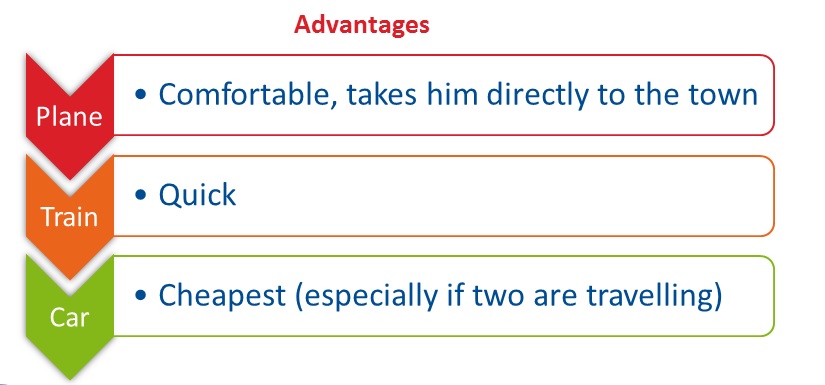
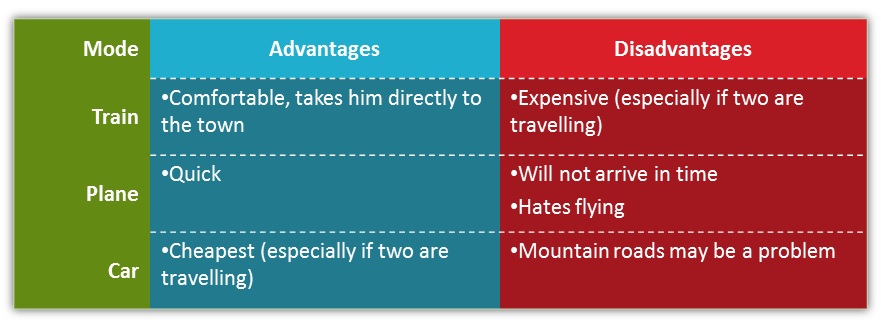
These colourful diagrams sort out the advantages and disadvantages and lay them out against the three modes of transport. It’s logically correct but not persuasive because its primary structure (separating advantages and disadvantages) doesn’t reflect the way we think, the process of decision between modes of transport involving immediate comparison of advantage and disadvantage.

This one is better:

analysis 3

This one better still, because it enables comparison more easily.

analysis 4

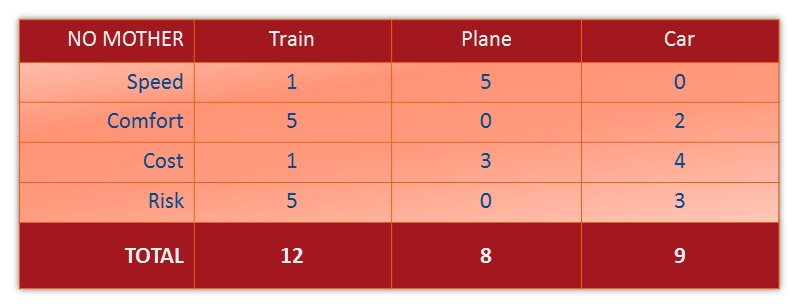
But none of the above provides a very deep analysis of the issue. They simply lay out the facts as divulged. Better, perhaps, to group each ‘determinant’ by ‘category’ – such as speed, comfort, cost, and risk. This involves deeper judgement as to what matters when a traveller must make a decision.

analysis 5

It’s more helpful because it enables us to ask the traveller, ‘What matters more to you? Is it comfort, or speed, or cost or risk?’ It lays bare the fact that we must first decide what matters most before a decision can be made.

You might even go a stage further and develop an ‘algorithmic’ way of representing the data so that a decision can be derived from the way the data are represented.

Supposing we assign the following weightings to these four categories:

  • Speed – 6
  • Comfort – 7
  • Cost – 8
  • Risk – 8

analysis 6

analysis 7

We show the data for the two different situations – with mother and without – and the diagrams deliver a decision for us, which is Train in both cases.

Of course the result would be different according to how you weight the categories.

I find the discipline of describing and representing a problem the most important step in terms of coming up with a solution. I try one way and find that the facts don’t fit, or that there’s something awkward in the way I’ve chosen to describe things, and then I try another until I arrive at the right way. And if I’m lucky a solution tumbles out.

See also:

The Art of Consulting

The Art of Consulting – What’s the Role of the Consultant?

The Art of Consulting – Impartial, Honest and Independent

The Art of Consulting – The Essential Skills

The Art of Consulting – Listening

The Art of Consulting – What’s a Good Question?

The Art of Consulting – Listening

Share

Ask anyone what their idea of a salesman is and they’ll usually tell you it’s someone who doesn’t stop talking, someone who wears you down with words until you surrender and buy, just to shut him up.

But it’s not like that at all, at least not outside the world of second hand cars and home insulation. The best salesmen listen more than they talk, and that’s true of the best consultants too. After all, consultant comes from the Latin verb consultare, to discuss, and discussion must be at least two-sided.

Listening is the basis of everything. There’s no possibility of your giving your client some good advice until you’ve understood what his problems are. And the best way of finding them out is to listen (and use all your other senses too).

ears

But listening isn’t just a matter of sitting back and letting sound assault you. It’s work. It needs concentration. You must listen neutrally, deeply, sensitively and critically. It isn’t necessarily the downhill free-wheeling part of the consulting process.

Listen neutrally

Especially during the early stages of the consulting process you must listen neutrally, and avoid listening selectively to fit the evidence to the theory you’ve already constructed or are constructing. Don’t just hear what you want to hear. Record the evidence that refutes your theory as assiduously as that which supports it. Whatever theory you put forward must accommodate the evidence that goes against it.

And when you hear things that you disagree with, don’t combine argument with listening. The time for argument comes later. Listen as comfortably to things you don’t like as to the words that confirm your views.

Listen deeply

Sometimes people say the opposite of what they mean. That includes lying of course, for which you must always be alert. But sometimes it’s more complicated than that. It need not be as dramatically evident as in this song by Kurt Weill – Je ne t’aime pas – but people may be constrained by loyalty to say things they don’t really believe, and if you listen deeply and thoughtfully you can tell.

Listen sensitively

General Practitioners often say that the most important moment in an appointment comes at the end. The patient has explained the relatively trivial pretext for his or her visit, the doctor has produced a prescription, then just as he or she is about to leave, the patient says, ‘Oh, I know it’s probably a very silly thing, but I’ve got this lump…’

Listen to everything, and give equal weight to what the speaker regards as trivial or serious.

Listen critically

Think about what makes the speaker says what he says. Always consider the advantage or disadvantage to be gained by the speaker from what he says. Most of the people you listen to have an interest in the outcome of your engagement and will want to influence it.

And listen with a pen, pencil or keyboard…

Always make notes of what you’re hearing. And always seek clarification if something isn’t clear. You will never be a fool if you ask for repetition or clarification, regardless of the irritability or impatience of the person you’re talking too. Don’t let acronyms pass you by without getting the speaker to spell them out. How often I still listen to people who say things like, ‘The trouble with the CFD is that the TKIO doesn’t really understand the aims of the NNBVC.’ Everyone has their own familiar technical vocabulary and their own shortcuts. They often use these to establish their own belonging and to demonstrate that you’re an outsider, consciously or otherwise. Don’t let them get away with it!

Above all, when you’re listening, make sure you’ve understood everything. If you allow inaccuracy and misunderstanding to creep into the process at the earliest stage, it will only be amplified as the engagement continues, and the end result might be wildly inappropriate.

See also:

The Art of Consulting

The Art of Consulting – What’s the Role of the Consultant?

The Art of Consulting – Impartial, Honest and Independent

The Art of Consulting – The Essential Skills

The Art of Consulting – Impartial, Honest and Independent

Share

In my last post on the Art of Consulting I compared a consultant to a waiter. My aim was to consider the balance of customer service (attempted compliance with the customer’s perceived agenda, at least) and honest advice.

  • The first waiter is willing to provide whatever the customer wants.
  • The second offers a menu but with no recommendations.
  • The third recommends certain items from the menu.
  • The fourth advises the customer to go elsewhere.
  • The fifth tells the customer he doesn’t look well enough to eat.

Which of these behaves most like a good consultant?

The Art of Consulting

The Art of Consulting – What’s the Role of the Consultant?

My own view is that a consultant must always be:

  • Demonstrably expert
  • Demonstrably experienced
  • Unequivocally honest
  • Of good repute
  • Impartial and independent (or declare his interests)

The first waiter sounds like he’s intent on the best possible customer service, though in reality I find it hard to believe that ‘anything is possible’ at short notice. (There’s a myth that Harrods in London will sell you anything you want as long as you can pay for it, but I find that hard t believe too!) But a consultant doesn’t just do anything the customer asks him to do. Rather, he advises.

The second waiter, who offers a choice from a menu, but without offering advice, sounds like a consultant I once employed in my company. He was one of the cleverest we ever had and could absorb the capabilities of a business software system simply by reading a manual from cover to cover (and even seemed to enjoy that experience). He was also eager to please. At the time I compared him favourably with another more plodding consultant whom I’d employed for far longer.

So I was somewhat surprised when a client begged me to send them the plodder rather than the clever one. ‘We can see that XXXXXX is clever, and that he knows his stuff,’ they told me, ‘and we do like him, but he won’t tell us what to do. He gives us at least four options to choose from, and, frankly, we don’t know which of the four options is the best one. YYYYYY on the other hand just offers us one option and we get on with it, and as far as we can tell, the options he recommended have all worked.’

Intellectual uncertainty, and rational self-doubt, however justified, are not what customers are looking for.

True, the third waiter also offers a choice, but the he also lays out the premise for each one – ‘If you like fish…’, or ‘If you like meat….’. This sounds more like a consultant to me.

But what about the fourth? The fourth is alarmingly honest, and the fifth is almost offensively honest.

Both act against their immediate interests – revenue (and tips). At least they appear to. And this lends credence to their advice. But what if the fourth waiter has a stake in the restaurant to which he sends the customer? This raises a point about independence and impartiality. Independence and impartiality must be both real and apparent. A consultant must always declare his interests, whether financial or merely psychological (such as friendship with a potential supplier).

Some consultants (for example, in the world of business software) are more closely allied with a particular product than with others, and have more experience of it. The customer must be made aware of this. It is not always possible to rid oneself of all influences.

In my early days in the business, working for Coopers & Lybrand in 1991 in Budapest, I had a small stake in a local company that was reselling the British financial system, SunSystems, which was already a popular choice for multinationals investing in former Communist Eastern Europe. I was asked by Coopers & Lybrand to advise Shell on systems. This clearly created a conflict of interests, but once I had declared my interest, and given that Shell were likely to choose SunSystems anyway, it was seen as an advantage by Shell that I knew the system and could help them with it.

In fact, I like both of the last two waiters. Honesty must sometimes trump business advantage. If, as consultants, we really don’t think that we can help a client (either because we don’t know enough or even because we’re not going to be available) then we should turn the business down. In the virtuous world we live in, this often redounds to our advantage at some later time.

The last level of honesty is difficult, and it’s only possible if the relationship is already strong. Remember, messengers sometimes get shot. So perhaps I would recommend the waiter who comes somewhere between number four and number five and is very sensitive to the situation.

Dont-shoot-the-messenger

The Art of Consulting – What’s the Role of the Consultant?

Share

From time to time, I run training courses on Non Technical Skills for Consultants and one of the first questions I ask participants concerns the relationship between consultant and client.

After years in the field we consultants take this relationship for granted, but it’s actually a slightly tricky one. We’re engaged to provide independent and impartial advice to our clients, but we’re also paid for it. On the one hand we must do what we’re told, and on the other hand we tell our clients what to do.

Conflicts of interest in consulting have an infamous history. Remember the ENRON scandal and its aftermath. When the big audit firms provided consulting services to their clients they had an interest in being a little more ‘understanding’ of accounting lapses than they ought to have been. Being nice to their audit clients won them millions in consulting fees. The link was never explicit, and perhaps in some cases it wasn’t even conscious, but even so, the consequence of the scandal were that the big audit firms were forced to shed their consulting practices and firms were required to change their auditors more frequently.

So, where do we consultants stand? Are we told what to do, or do we tell?

Those of us who have been in the business too long might, at this point, and with a wry smile, plead the ‘psychoanalyst’ position, and claim that all we’re ever expected to do, as consultants, is to listen sympathetically to what the client says, ask a few very open questions, and then agree with whatever position the client takes. You certainly don’t get fired that way. But it’s not my way.

In my training course I draw a parallel with the way a waiter might present his restaurant’s offering to a guest, and I ask participants to tell me which waiter is most like a consultant.

waiter

The Compliant Waiter 

The compliant waiter is eager to provide his guest with whatever he may ask for:

Good evening, Sir. No, Sir, we don’t have a menu. This is perhaps an unusual restaurant. We take pride in offering you the best possible service. We give you exactly what you want. Our chef can cook absolutely anything. Just tell me what you’d like.

The Conventional Waiter

The conventional waiter offers a menu of options.

Good evening, Sir. Here’s our menu. You’ll see that we have a wide variety of dishes, all of them good. Just tell me what you’d like.

The Advising Waiter

The advising waiter offers his own recommendations from the menu.

Good evening, Sir. Here’s our menu. You’ll see that we have a wide variety of dishes, all of them good. But we’re especially famous for our fish, and the lemon sole is particularly excellent today. But if you prefer meat, then the sirloin steak is the best we’ve got. Just tell me what you’d like.

The Honest Waiter

The honest waiter puts the interests of his guest first, and seems abandon commercially sensible behaviour, sending his guest to another restaurant (perhaps in the hope that he will return on a better day?).

Good evening, Sir. Here’s our menu. You’ll see we have a wide variety of dishes, all of them usually good. But just between you and me, the chef had a tiny bit too much to drink last night. If you really want to eat well, then come back another time. You’ll do better today at that restaurant across the road. I ate there myself last week and it’s really pretty good.

The Extremely Honest Waiter

The extremely honest waiter is intrusive!

Good evening, Sir. It’s nice to see you again. I have to say, though, that you don’t look your best this evening. In your present condition I’d say you’d be much better off not eating anything at all.

Which of these is most like a consultant?

Let me know your thoughts.

This is the second post in a series on the Art of Consulting.

The Art of Consulting

The Art of Consulting

Share

To my mind there is no better job in the world than that of the consultant.

My own field of consulting is business IT, but whether you’re an architect designing a building, an engineer designing a car, a doctor diagnosing an illness, a systems analyst creating a system, a detective investigating a crime, or a lawyer constructing a case, the excitement is the same.

What does a consultant do?

A consultant uses his knowledge, experience, intelligence and imagination to investigate, understand, and advise on the resolution of problems brought to him by a client. He may also manage the task of resolving the problem.

consultant 1

The process is similar, whatever the profession. There’s an investigative phase, which involves researching, listening, questioning, and confirming. There’s an advisory phase, where a solution or a number of solutions must be put forward to a client. And finally, though not in all cases, there’s an execution phase, when a solution is implemented.  The last requires the additional skills  of pragmatism and persuasion beyond those involved in diagnosis.

I wouldn’t do any other job. Even though I manage a number of companies, I’m still involved in sales and consulting. And I’m still excited by the first days of the sales process, when I must, as rapidly as possible, understand what an organisation might need a system to do, whether the organisation is making chocolate, selling insurance, monitoring expenses, scheduling services, or extracting sugar from sugar beet.

As an IT consultant I’m interested in understanding what an organisation needs to know in order to run a business well, and what it is practical for me to suggest. And when a ‘system design workshop’ begins if  our software or ideas have been chosen, there’s nothing to beat the concentrated effort involved in gathering opinions, reviewing a business from top to toe and then inventing a solution.

Every client, every business, every culture in which you work, is different. You learn about so much from so many different people. If you’re good, you’ll end up not as a Jack of All Trades but a Master of None, but as a Master of Many Trades. When I think of how I might have spent my professional life, quietly, perhaps equally prosperously, unambitiously doing nearly the same tasks every day, I rejoice in my good fortune. Never mind the stress of failing to sell more often than not, of long hours, of distant travel, of uncomfortable hotels, of demanding clients, the sheer intellectual challenge justifies it all.

I’ve spent 30 years in consulting, and now run a business software consultancy and reseller. I’ve seen a lot, but there’s always something new for me to think about each day. But one of the things I’ve learned over the years is that some of the essential skills of consulting are not particular to a profession. They’re needed by the lawyer, the engineer, the PR consultant, the architect, by anyone who must research, listen, question, imagine, devise, design, explain, describe, sell, persuade and implement.

So, in a series of posts I’m going to write about some of these skills and how a consultant must bring them to bear on what he does. And, as the title suggests, I firmly believe it’s an art, not just a skill. Imagination plays a hugely important role in the process. Consulting is creative.