The Scribblings of Convicts

The most infamous of books written by jailbirds is almost certainly Mein Kampf, Hitler’s torrent of crackpot history and racist nonsense, written whilst he languished in jail after the failed Munich putsch of 1923. It has recently emerged from copyright and was republished in an annotated scholarly edition a week or two ago.

But there’s a respectable tradition too, including John Bunyan’s late 17th century spiritual allegory, The Pilgrim’s Progress, begun in Bedfordshire County Prison. Other literary luminaries of the prison cell include Cervantes, Oscar Wilde  Nelson Mandela, e e cummings, Jean Genet, and Martin Luther King.

prisonwriters

Perhaps in the hope of contributing to this tradition (though not, I trust, in the vein of Mein Kampf) the Romanian legal system allowed, under a law passed in 2006, a reduction of 30 days from a prisoner’s sentence for each academic book written and published whilst in jail.

The incentive worked. Some 300 books were published by prisoners last year, one of them, a 213-page work, written in under seven hours.

Sadly, Justice Minister Raluca Pruna recently announced that the law would be annulled by emergency decree.

“According to prison administration figures, the number of books published by detainees went from one a year between 2007 and 2010, to 90 in 2014, and 340 last year,” Ms Pruna told a news conference. 

“Given that the phenomenon has spiralled out of control, I have proposed that the government repeal this arrangement via emergency decree,” she added.

Romania’s jails have recently been filled with the great, the good, and the rich, as a result of a large-scale drive against corruption, and whilst there is much that these prisoners might write about, and they certainly have time on their hands, it is widely suspected that some of their works may not be entirely their own. Romania’s anti-corruption prosecutors are investigating.

Businessmen Dan Voiculescu and Dinel Staicu top the list of literary prisoners with ten books each. Voiculescu’s record is especially impressive, given that his sentence only began in August 2014.

Another jailbird on the list is businessman Gheorghe Copos, who was sentenced to four years incarceration. According to The Guardian, Copos was accused of plagiarism for a book entitled Matrimonial Alliances as a Policy of Romanian Kings in the XIV-XVIth Centuries, a subject in which he had shown no previous expertise. Catalin Parfene, a journalist who wrote a thesis on this subject for his master’s degree at the University of Bucharest, told The Guardian that the book had a structure identical to his own work, and repeated his arguments and ideas. Nevertheless, Copos was released from jail, and will presumably devote the rest of his life to further historical research.

Sadly, if this enlightened law is repealed by decree, Victor Ponta, Romania’s former prime minister, to whom a prison cell might yet one day be allocated, must set aside his academic ambitions and the chance to atone for plundering others’ texts for his doctoral thesis.

You are nothing in Romania unless you have an academic treatise to your name. Even Elena Ceausescu, the largely uneducated wife of the Communist dictator who ruled the country until 1989, had the time to pen a work on polymer chemistry. It didn’t save her, though, from getting shot with her husband after a travesty of a trial on Christmas Day 1989.

What’s the News in Bucharest?

laika

‘What’s the news in….. ?’ may be an unexciting opener, but it’s often the first question I ask when I arrive at one of our far-flung offices (LLP Group). It’s an open-ended question, and a good conversation starter, but I also ask it because I’m genuinely curious. What makes the news in Sofia, Budapest or Bratislava mightn’t have hit the headlines on the BBC or Sky.  

So, ‘What’s the news in Romania?’ I asked my Romanian colleagues yesterday as we sat down for a mid-afternoon Christmas lunch (the second in two days). They should know by now, of course, that what interests me is scandal and gossip, political or otherwise, but in the concerned silence that followed I suspect they were scratching their heads for trade balances, GDP growth, inward investment figures, and so on. Who cares about such things at this time of year, or ever, for that matter?!

‘I’ll tell you what’s the news in Britain,’ I offered, as the pause lengthened. ‘We’ve just sent a man on a dangerous mission to space, and another one on a dangerous mission to Brussels to renegotiate the terms of Britain’s EU membership. And a thousand happy and relieved immigrant Syrians are already complaining about the weather. If that’s not assimilation, then I don’t know what is.’

‘Been there. Done that. We sent our man into space years and years ago,’ one of my colleagues proudly pointed out, though it was probably before she was born.

‘And did he come back?’ I asked. And from there we quickly got to the factoid that I was born on the day that poor ‘one-way-ticket’ Laika (a Russian terrier of some kind, I believe) was blasted into space.

‘I saw Angela Gheorghiu in the street,’ another colleague offered (perhaps knowing that I have a soft spot for opera, if not for preening divas).

It was a gloomy afternoon, and the background music was funereal, though the words, apparently, were Christmassy and joyful. A sense of the absurd prevails in Romania and Romanians are naturally and properly distrustful of Government, of the Judiciary, of officialdom in general. I shouldn’t have expected good news.

To my mind, some of the best recent news has been the resignation of the Prime Minister, Victor Ponta, already a proven plagiarist, and the possibility that he might be charged with criminal fraud. But according to my colleagues it’s quite likely that a deal’s been done and he’ll avoid prosecution as a reward for resignation. So much for an independent legal system.

The fact that Romania’s jails are crammed with corrupt politicians and corrupt businessmen and women should also be cause for celebration, I thought, but there’s a sensible ‘let’s wait and see’ attitude about whether the judiciary is truly independent and sufficiently powerful. After the next election it’s possible that the jailers and the jailed will simply swap positions.

There’s also an interesting story about dogs. Romania, and particularly Bucharest, has always had too many. Former President Basescu, when Mayor of Bucharest, impressed his electorate by sterilising the wild canine population of the city, to non-Romanian Brigitte Bardot’s dismay (see Street Dogs). Some dogs were also offered to the Russian space programme, but were refused as being insufficiently Russian. Now, apparently, the aim is to forbid farmers from possessing too many – a ‘one dog on the plains and three dogs on the mountain policy’ is to prevail in rural Romania (see Romanian Shepherds Protest Dog Policy).  Who the beneficiaries might be (ramblers?) is not clear to me, but the result was an invasion of farmers waving agricultural implements that brought traffic in the city to a standstill on Tuesday. It’s good news of a kind, I suppose, that Parliament has nothing more important to debate.

Parliament has also brought a number of businesses to a halt by forbidding the public use of buildings over a certain age unless they’re certified as possessing sufficient structural strength to survive the next, long overdue, earthquake (see Might Close Down).

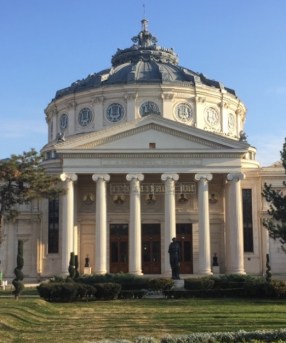
It was a jovial afternoon, and the food and wine were good, even as the sky darkened and the rain began to fall. It was a cold walk to the Athenee Palace Hotel.

atheneum

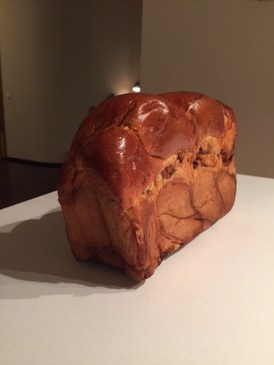
Thursday was, by contrast a glorious day, and it felt as if the news could only be good. The sun was shining brightly on an ever-tidier Bucharest. Secret Santa called at the office while I wasn’t looking and left me with very good news indeed – a loaf of traditional Christmas bread (here shown a little squashed during my onward journey to Budapest).

bread


Copy Cats

I’m fascinated by mathematics, though my own understanding of it peaked at 18, when I was merely competent, never precocious. I wonder from time to time, as we all do, what mathematicians are actually ‘doing’ when they retreat to think and squiggle.

squiggle

I touched on the philosophy of mathematics when I was at university and I remember reading about Bertrand Russell’s and Alfred North Whitehead’s massive three-volume Principia Mathematica, which sought to derive mathematics from the basic principles of logic (an undertaking that Kurt Godel later showed to be impossible). Though it may not be true, I was amused by the story that it’s only after about 500 pages that you reach a sentence that reads ‘..and so therefore 1 = 1′. I never read the book, nor will I, not least because you need a wheelbarrow to carry it around.

I am fascinated not by the squiggles but by the mathematical struggle itself, and I recently read a layman’s account of Andrew Wiles’ heroic 1995 proof of Fermat’s Last Theorem (after 358 years of effort by the mathematical community) with great excitement but little understanding. Proofs are like ‘discoveries’, akin to the discovery of the South Pole, or the first landing on the moon. The outer reaches of mathematics are uncharted territories, waiting to be found, mapped and possessed. Wiles’ proof was like the discovery of  the North West Passage, the finding of a route from one impossible mathematical place to another.

But of course mathematics isn’t anything like ‘discovery’ in the geographical sense. There isn’t any mathematical ‘reality’ out there for mathematicians to explore. It’s just a game with symbols, perilously constructed on a simple foundation of 1,2,3,4,5,6…. and so on. Who chose, for example, to extend the rules of that game to allow the square root of a negative number?

But the wonderful thing, I am told, is that it’s not a pointless game at all, not just a form of amusement for very clever people. Mathematics, together with all those improbable extensions that take it well beyond what most of us can grasp, and well beyond any use that most of us might have for it, has proven a useful tool for science. Those flights of fancy and intellect have practical applications in areas such as quantum theory.

So, I was excited to read yesterday that another of the great unproven hypotheses of mathematics had finally been proved – Riemann’s Hypothesis, which has to do with the distribution of prime numbers. Indeed its mere statement, unlike Fermat’s Last Theorem (no three positive integers a, b, and c can satisfy the equation an + bn = cn for any integer value of n greater than two), is beyond most of us.

Riemann’s Hypothesis is one of the seven somewhat difficult Millenium Problems listed by the Clay Mathematics Institute. Solve any one of these and you’ll win a million dollars.

What I read yesterday was that Riemann’s Hypothesis has been proved by a university lecturer in Nigeria, Opeyemi Enoch, who was inspired by the enthusiasm of his students to give it a try.

But apparently it isn’t true, and the Clay Mathematics Institute still lists the problem as unsolved. Other sources report that the theoretical papers Opeyemi Enoch had referred to were neither his nor an accepted proof of Riemann’s Hypothesis. Probably a case of plagiarism. See Not Proven.

Plagiarism seems so foolish nowadays, so unlikely to succeed. There are many tools to hand (one of them being Google) that will quickly determine  if a paragraph of text has been ‘borrowed’. You wonder why anyone still bothers. It’s a risky practice. But accusations of plagiarism still bring down the high and mighty, or, in some cases, should do so if the plagiarist possessed a modicum of shame.

Romania’s former Prime Minister Victor Ponta, who resigned a couple of weeks ago, currently stands accused of corruption and may face trial, but some years ago he blithely sailed through very plausible accusations that large parts of his doctoral thesis were copied.

Plagiarism, one must remember, is a time-honoured tradition in Romania. Elena Ceausescu, wife of the former dictator, received a number of academic awards for her work on polymer chemistry, though when she left primary school she was proficient only in needlework. It is unlikely that she could have understood even the first page of her 162-page thesis.