Facebooks before Facebook

It’s the time of year when pupils are graduating from secondary schools all over Europe. You notice it particularly here in Central and Eastern Europe because each graduating class creates a kind of Facebook and places it in the window of their town’s most prestigious café, department store or bookshop.

facebook 2

It used to charm me in the late 1980s when I lived in Budapest, since we never did this when I was at school, but what’s depressing is that, although 28 years have passed, these pre-Facebook Facebooks haven’t changed at all.

Graphical styles have undergone all sorts of revolutions since 1987, and the whole of Communist Eastern Europe has revolted politically and been liberated from the straitjacket of Marxist orthodoxy, (which has always given a rather serious cast to education) but it might as well never have happened. These displays of (probably) bright young lives and their teachers are still as dull, as dreary, as empty of originality and promise, as they always were. See a particularly dire example, above, from a window (albeit of a religious bookshop) in Debrecen.

Look carefully. The only male teacher without a tie is the drama teacher (you wonder if he will ever be promoted after this sartorial dare) – and only he and his theatrical colleague permit themselves a slightly open-mouthed smile. Of course, a certain license has always been permitted to the more expressive arts. Otherwise it’s all pursed lips, at least for male teachers of mathematics, chemistry, history, and literature. And men, of course, have their greater dignity to consider, whilst women may smile a little more informally.

drama smiles

‘Kati Neni’ (‘Auntie Kate’), plum centre of the picture, and this year’s class teacher, has something rather unsurprising to say.

‘Finally, it’s over!’

kati neni

I imagine she says this every year, but whether in sadness or relief we cannot tell from her expression.

Deputy Director Katalin is a dead ringer for a 1970s Miss Moneypenny

deputy director

And her colleague, the second deputy director, looks a tiny bit mad – a good candidate for Q.
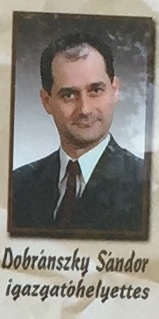
other deputy director

As for the pupils, properly relegated to the lower ranks, the only one who looks remotely like fun is Mizi Marietta, who, with a name like that must go on to a starring role in a new operetta by the dead but much-loved Franz Lehar.

mizi marietta

20 girls, 7 boys. What’s happening in Debrecen? Are boys now exposed at birth on the Puszta to be picked at by vultures?

And why do they all wear black and black ties? Is graduation a kind of funeral?

Now, I must also confess that although I have a particular love for Hungary, since, in a certain sense, I grew up there, I couldn’t help thinking, when I saw the Czechoslovak Facebooks in all the shops in Prague in the same late 1980s that they did it rather better there. They were funny, irreverent, imaginative, unconventional. Is there a deep-seated conservatism about Hungary that has resisted change over the last 28 years (and for how many decades before)? Or is it just this eastern part of Hungary that is stuck in the Puszta mud?

Anyway, boys and girls, do try harder!

On My Bike

I’m on holiday, bicycling from Miskolc in North-East Hungary to Timisoara in South-West Romania, largely in order to demonstrate (mainly to myself) that I am still young and vigorous. The first day couldn’t decide the issue, though. After a wrong turning on the outskirts of Miskolc, but stubbornly refusing to retrace my steps, I made a 70 km ride into a 95 km ride and arrived in Nyiregyhaza exhausted, as anyone, young or old, might have been.

The starting point of the trip, at least, is in no doubt, but time will tell if I manage the 362 kilometres (as the crow flies, not as the bicycle rolls) from start to finish. Boredom, weather, fatigue, mechanical failure, puncture, and (let’s hope not) accident may curtail the journey.

I’d planned, in fact, to bicycle through Sub Carpathian Ruthenia, but when I explained to anyone interested (and some who were not) that this is just the inner edge of South-Western Ukraine, and therefore a rather welcoming place, I was told not to, on the grounds that kidnapping, accusations of spying, and other mishaps were almost certain. Never mind that this is the Europhile part of Ukraine and was once Czechoslovakia and Hungary (before the Second World War), and Austro Hungary (before the First), and even, for one day, an independent Ruthenia (see Economist).

I thought it unlikely that I could pedal into a warzone from there (I would have to cross the Carpathians for a start and then go on at least another 1,000 km) but I am heeding their warnings and will stay on one or other side of the Hungarian-Romanian border.

bike route

What is there to see?

Large fields of wheat, and maize, large fields of spindly green things that could be fennel (is that unlikely?). Road workers resting by the road, farm workers resting by the fields. Low bungalows in small villages apparently empty of people. Birds. A hare. Above all the tarmac unrolling in front of me, which is all that really matters, getting me from A to B.

But I do notice that the region looks more prosperous than when I was last here, twelve years ago. Agricultural machinery is modern, even monstrous, no longer on the old slow human scale. Village houses look less shabby, and Debrecen, capital of Eastern Hungary, has undergone a radical makeover. The great Calvinist Church has been painted, the streets are tidy and lined with elegant cafes, and an impressively modern and quiet tram slithers through the central square. Sleepiness persists, of course, though more tidily. This part of Hungary hasn’t been in a hurry since the revolution of 1848.

One thing hasn’t changed. Stopping for water about 20 km from Debrecen I engaged a kindly middle-aged lady in conversation (to the extent that my declining Hungarian allows). When I told her what I was doing she said ‘Watch out for the cigany’, and in case I didn’t understand this she said it another way, ‘You know, the brown people. They will rob you if you give them a chance.’ Casual racism persists here, as all over Central  and Eastern Europe.

At Keleti Station in Budapest – in the film noir style.

adam bicycle

Yesterday’s Freedom Fighter

I was living in Budapest in June 1989 when Viktor Orban made his impassioned speech in favour of free elections and against the presence of Soviet troops in Hungary. The occasion was the reburial of Imre Nagy. This reburial of the executed reform-communist who led the ‘counter-revolution’ in 1956 was astonishing in itself in a country that was still a one-party Communist state, but that Viktor Orban, then just 26 years old, should be allowed to make a firebrand speech against the Communist regime and Communism in general was even more remarkable.

[Incidentally the night before saw the most moving example of quiet political power that I have ever witnessed. Opposition politicians (a new breed of citizen in 1989) had asked all those who were opposed to the Communist regime to place a lit candle in their window. I passed through the streets in a taxi late in the evening and there was a candle in every window. If you were a Party bigwig then that night you knew for sure that your time was up.]

Viktor Orban 1989

I had been in Hungary since the summer of 1987 and had seen the Communist regime gradually decaying, ever more rapidly after Gorbachev had promised not to interfere. I was working as a consultant on a long MRP software implementation for a television factory, Videoton, in Szekesfehervar, a town about 80 km from Budapest, and I well remember my Hungarian colleagues advising me to stay off the streets on the day of the reburial. They feared a violent crackdown on the emerging opposition, something like 1956 all over again. But of course nothing of the kind happened.

Viktor Orban was then astonishing – radical, energetic, a freedom fighter willing to take personal risks for his cause. Admirable, it seemed at the time. And today he is Prime Minister, fomenting petty nationalism and intolerance.

I loathe the views attributed to Viktor Orban in this article:

Migration threatens European civilisation: Hungary PM

Viktor Orban Now

Some rhetorical questions:

Why should Europe be Christian? Our ethical viewpoint is more ‘Abrahamic’ in origin than merely Christian, its assumptions shared by Jews, Christians and Muslims alike. And, importantly, shared by the secular, even atheistic majority to which I belong. And by people of other faiths, too. The majority of Europe’s population may be Christian by faith or culture, but that is not what unites us.

What about the good Samaritan? Christianity teaches charity, even to the stranger. We must make a place for those who make it to our shores.

What do Hungarians have to fear? The Hungarian language and culture have survived a thousand years of siege by other cultures and languages, and occupation by some. Why should they fear anything now? Cultures are resilient.

Why shouldn’t a culture evolve and change? I live partly in London, which remains a British city even if a large minority of its inhabitants were born outside it. It is one of the most vibrant, exciting, innovative cities in the world, stimulated not held back by its multicultural character. Would that Budapest were similar!

Isn’t there a slight whiff of hypocrisy about all of this, if you consider Europe’s colonial past? Hungary was not, of course, as adventurous in its propagation of Christian civilisation as many other European powers, but if Viktor Orban speaks for Europe as a whole he might be sensitive to the invasive attempts by Europe to impose an alien culture on more ‘primitive’ societies in other parts of the world. And rather more aggressively than by simply living quietly by another faith as an immigrant.

Hungary has, in recent years pursued a policy of petulant independence, as if modern sovereignty is not diffuse, whilst at the same time obtaining great advantage from EU and NATO membership. You can’t have it both ways.

I hate nationalism. By defining ‘belonging’ we define the ‘other’, and the other becomes the scapegoat and the enemy. It is dangerous.