Blingless in Sofia

There are large parts of the world where many of those of moderate wealth, and all of those of great wealth, have acquired their possessions questionably. In such places bling abounds. If there are ‘expensive’ restaurants for business visitors or tourists they tend to be decorated brightly, opulently and ostentatiously, with the undiscerning, and undeserving, rich in mind. They are peopled by fat-bellied, swarthy gangsters, shouting into their mobile phones, blowing cigarette smoke with arrogant abandon and largely ignoring their blonde and leggy molls, who look on vacantly, even anxiously, uncertain of their tenure.

Such was Sofia some fifteen years ago, and such is Moscow still, and probably Almaty. If you weren’t wearing Gucci, or Versace, and weren’t dripping with ill-gotten gold, you were consigned to a table in a dimly lit corner of the restaurant, to be served, eventually, by reluctant waiters, and glanced at with sneering pity by more profligate and better-tipping oligarchs.

I feel a great nostalgia for such times. There was an edge to travel in the newly free democracies of Central and Eastern Europe that has been lost to normality. It was an adventure. Now it is merely a pleasure.

I’m in Sofia for two nights on the first leg of a four-country tour of LLP Group’s offices in Bulgaria, Romania, Hungary and Slovakia, before returning to my home city of Prague, and then on to the UK for Christmas with my mother. I’m travelling not on a Santa-style sledge, drawn by flying reindeer decked out in our company’s colours, but by low-cost airlines, which take me through two additional capitals, Belgrade and Berlin. If time permits I might also make a detour to Vienna on Sunday, since I have designs on Demel, the great Viennese café and cake shop, who make the best stollen and gingerbread in the world. I need stocking fillers for Christmas.

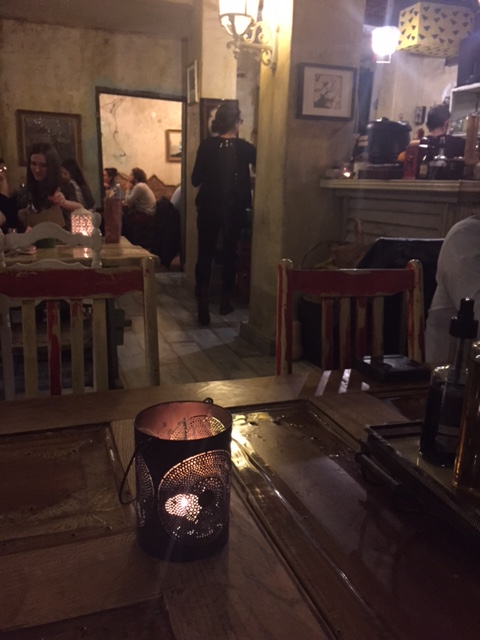
The purpose of my tour is unambitious and largely gastronomic. I take my colleagues out to lunch or dinner. I bestow Christmas goodwill, and listen to their woes and joys. Yesterday I took my Bulgarian colleagues to my favourite place in Sofia, the entirely bling-less Made in Home, a restaurant that is the antithesis of gangsterism, ostentation and tastelessness. The blingy rich wouldn’t even be seen dead there, though, aware of it or not, they’re far more likely to be seen dead at the places they do frequent. Its décor comes from grandmothers’ attics, bizarrely juxtaposed with original modern paintings and prints. Its chairs are a mismatched collection from the last ten decades, and your table may well have been made from a door. It’s cosy, friendly, inexpensive, and peopled by people of all kinds, none of them eager for display, and the food is absolutely excellent. It is the kind of place you might find in New York, London, Tel Aviv, or Paris, but that’s not to suggest it’s bland.
sofia1

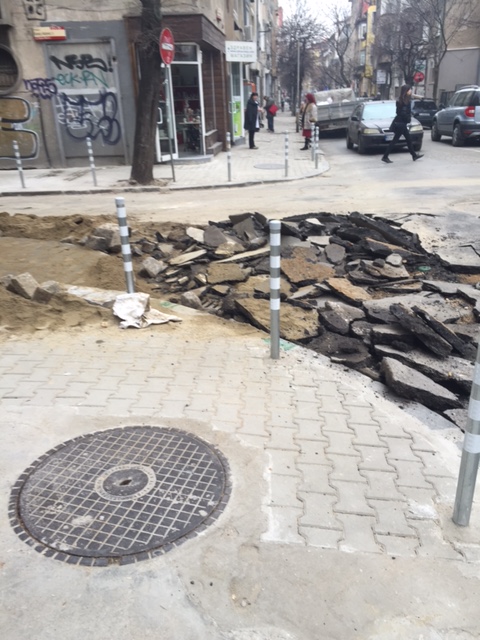
We booked a table for 12.30 and although we set out from the office at 12.15 we were lucky to arrive before losing our table. Traffic in Sofia is appalling, made worse by breakdowns (see my colleague Stoyan removing an overheated car from our path) and by road works. Sofia, one of my favourite cities in Eastern Europe, is still being remade.

sofia3

sofia2

We enjoyed an excellent lunch, choosing from a menu that included Bulgarian as well as ‘international’ dishes. The emphasis is on vegetables, but you can also eat fish and meat. It was so good I returned, alone, for dinner, and ate the zucchini patties with yoghurt all over again.


FPPs – Mitigating Some of the Risks

Share

I’ve written two sets of notes on the risks of Fixed Price Projects in the world of ERP implementations. My own experience at LLP Group has taught me that the more thought and definition you invest in a project before it’s started, the lower the risk for both you and your client. This is true irrespective of whether you are undertaking a fixed price or a time and materials project.

See

FPP – A Frightening Acronym

FPP – Estimating Fixed Price Projects

Although you would hope never to have to refer to it once a project has begun, the contractual paperwork and the project scope and definition that it refers to or contains, are of vital importance in establishing an understanding between you and your client. If you don’t encapsulate your thoughts, ideas and discoveries in these you might as well not have bothered. Protection is essential both for you and your client, and the best protection is a clear understanding precisely documented.

contracts.jpg

Contracting and Scoping

When you enter into an FPP agreement with a client inaccuracy is the devil, ambiguity is the killer, imprecision is the plague. There should NEVER be a list of tasks that includes completely unqualified items such as:

  •  8 Management Reports
  • Assistance with Data Import from legacy systems
  • Support during Go Live
  • Documentation
  • Etc

What’s wrong with these? They are open ended. What sort of reports? (And what is a report, anyway?) How much assistance with Data Import, and what legacy systems, and how many times? How long is Go Live?

So, an FPP must be well-scoped with dozens of pages of definitions and clarifications, and descriptions of what the client will get. And if all of this is done with a client who understands the FPP game, that both sides need protection from undue risk, this is perfectly possible. We should do it even if we don’t get paid for it. Ten days given for nothing before the project begins saves hundreds lost later. And if you do it well, you also have a chance to impress the client with your understanding.

These are some typical areas of risk:

  • Data Import/Transfer from Legacy Systems
  • Reports
  • Training
  • Documentation
  • Interfaces
  • G0-Live Support
  • Delays
  • Accuracy
  • Payment Terms
  • Get-Out Options

Let’s look at some of these:

Data Import/Transfer from Legacy Systems

This needs to be qualified:

You must list the systems from which data will be imported and the data items

You must quantify the data – how many records?

You must make it clear that you assume that the data are ‘clean’ (i.e will not fail repeatedly on import because they don’t conform to the requirements of the new system)

You must specify the format in which data are to be provided and make it clear that you are not responsible for and estimating for the job of exporting the data from these legacy system

Your scoping document and contract should include a clause such as this:

‘Our obligations under this agreement include the importing by us of data into NEW SYSTEM. To reduce the risk of an open-ended obligation to spend an unlimited time on this task, we assume that:

  • These data can be provided by you to us in text-file or Excel formats as specified by us and at the time specified in the agreed project plan, or if delayed, as notified to us with at least two days’ notice
  • These data are ‘clean’ in the sense that they conform to the parameters of NEW SYSTEM and do not need repeated correction and reimport (we assume that import will succeed by the second attempt)
  • You confirm the correctness of the data in NEW SYSTEM in writing before any dependent tasks in the project commence
  • Volumes do not exceed nnnnnn records from system x, nnnnnn records from system y, etc


We reserve the right to charge for any additional time incurred during the process of data import if any of these conditions is not met.’


Next time I’ll look at some more areas of risk that need careful mitigation.

FPP – Estimating Fixed Price Projects

Share

I posted a blog a few days ago on Fixed Price Projects (FPP – A Frightening Acronym). FPPs frighten me because part of LLP Group (a part I’m happy to have sold) worked with the wonderfully open-ended Microsoft Dynamics business software products. We sold, scoped, estimated, and executed such projects poorly, to the extent that we made no margin at all, sometimes on hundreds of days of consulting, even whilst satisfying our customers. Our consultants and developers were no doubt excellent, but our sales processes and project management skills were insufficiently sophisticated and cautious.

Because of this I’m wary of FPPs, even if I know that they can be done well, can be controlled and can be profitable. To that end, I try to make sure that everyone in the company is aware of the risks and how they might be mitigated.

My last notes were about the Sales process. Here are some thoughts about Estimating.

estimating

Estimating

Estimating is a process that must involve both the sales and the consulting/development team.

It’s a time-consuming business. But FPPs get off to a bad start if we calculate estimates poorly on the basis of incompletely understood requirements, and half-baked solutions. Even ten free days up front might save hundreds of days later.

Of course, it’s the sales team that has to sell the project and who, in conjunction with management, must decide on price (for a defined scope), but our sales and management team MUST listen to what the consultants have to say. If they say they must know more about the client’s requirements, then the sales team must provide them with more. Never be tempted to think ‘Well, if I add another five days or so, that’s bound to be enough’. It isn’t.

And ALWAYS add contingency to your estimate. (And then more.)

In the end it is a commercial issue as to whether you knowingly ‘sell’ fewer days than you know that you need to execute the project. Whether that is commercially wise or foolish has nothing at all to do with the deadly sin of starting a project with inaccurate estimates of how much time the project will actually take you.

What if your estimate is insanely too low, and you discover that once you’ve started the project?

Well, it’s important when creating an estimate to make your assumptions explicit. This isn’t a slippery way of avoiding commitment, a trick that you’re playing on the customer. No, it’s an honest statement of the basis for your estimate. If it turns out that there are material facts that you’re unaware of, then you’ll be glad to be able to go back to the customer and ask for more time. And make sure that you make it clear that it isn’t your fault that you didn’t ask. You need to include a statement like this one in your proposal:

This estimate is based on materials provided by the customer and discussions with [named individuals]. Whilst we have built a certain level of contingency into our estimates to deal with the unexpected, the following assumptions are material, in that if they are incorrect our estimates may be materially wrong in either direction. These assumptions are [examples]:

  • In valuing your inventory you use only one method of valuation, weighted average valuation in local currency in conformity with statutory tax regulations
  • In valuing your inventory you value it only in one currency
  • You have no need for lot tracking of purchased, intermediate or final products
  • Etc’


And very importantly…

  • Your staff are motivated and committed to the process of implementation and will provide timely support as required
  • Your staff will be available for the time that we have estimated is required of them’


If possible you should build the estimation process as a first step of the project itself, or present this as a project stage where estimates and assumptions are confirmed. If necessary, give some free days to this, since your risk is greatly reduced by it, and you have a chance to demonstrate competence.

But if you do this it is also important that you build into your contracts an escape clause.so that both parties can terminate the contract or renegotiate it if the estimates or assumptions turn out to be incorrect.

Sweetening the Pill

Share

‘People buy from people,’ we’re told, again and again, if we’re in the business of sales. It’s not about the product: it’s about YOU.

I say this myself to our sales staff in LLP Group and systems@work. We write and sell software, and provide the consulting days that make the software work. Of course, I don’t mean to imply that the software product and what it can do is irrelevant, but rather that in making our software work for a customer it’s only partly about the product, and as much about the skills of the people involved in the sale and implementation, including their personal skills of persuasion and determination. Assuming, of course, that during the sales process our sales staff are selling as if they are honest and realistic consultants, which, often, they have been.

People buy from people. And people buy from people they like. And sometimes people like people because they give them things.

Sales has always been a muddy business. The trick of making people like you should be about what you’re bringing to them ‘professionally’ rather than ‘personally’, but sometimes it isn’t. There are the dinners, the gifts, the ‘training’ trips, the nightclubs, the seats at sporting fixtures, all those benefits that oil the wheels of sales. They’re often above board, completely visible, accountable (even tax deductible) and bring no long-term personal benefit to the recipient, but sometimes they’re not.

The rule in my company is that anything we give to a client or a potential client  (and we set a very low maximum) the recipient must be able to declare to his or her boss. We give bottles of wine at Christmas, and we take our visitors out to dinner.

Sales is certainly cleaner than it was, but we’d be lying if we suggested that the reason we are generous to potential clients and existing clients has nothing to do with wanting their business. There are grey areas.

In the world of business-to-business software sales in the private sector it is not complicated. But it all gets much more difficult in areas where ethics and public money are involved, such as in the purchase of pharmaceutical products by publicly funded health services. Pharmaceutical products must be good for the patient, and affordable for the tax payer.

pills

Over the last few years the practices of pharmaceutical sales teams have come under the spotlight and, as in China recently, pharmaceutical companies have been prosecuted and fined for ‘bribing’ doctors to buy their products.

I don’t know if there has ever been direct under-the-table bribing, such as cash in brown paper bags, but the tentacles of pharmaceutical companies go so deep into the institutions they sell to that it’s difficult to disentangle the ethical from the unethical. They sponsor research, they provide samples, they run training courses, they pay for doctors to go to, and speak at, conferences, they run educational seminars, and often entertain on a lavish scale.  It is no wonder that the objective independence of those who recommend and prescribe particular products is undermined, consciously or otherwise.

So great have been some recent scandals that regulation has now begun to intrude on these practices. One consequence is that pharmaceutical companies must now track and report on all the ‘benefits’ they provide to Health Care Professionals (HCPs). This reporting is enforced both internally but also by statutory bodies. The value of all benefits must be reported by expense type, by organisation and by individual (and by the role they perform in the organisation).

This is where expense@work comes in. I’ve recently been engaged in trying to sell our expense management software to a pharmaceutical company that’s under pressure to provide exactly this kind of HCP reporting. It’s easy for us, and I can easily configure the system to track expenses not just by the elements that are needed for accounting purposes (expense type, description, gross value, VAT value and net value, in transaction and local currency) but also by organisation and particular health care professional (if appropriate) and by pharmaceutical product area and product.

I can picture the sales representatives assiduously entering these data into our system and I don’t suppose they would like doing it, but transparency in the slightly murky area of pharmaceutical sales is long overdue.

Pharmaceutical companies are essential. Where would be without them? And it is legitimate that they should actively advertise and promote their products. This means relationships with HCPs at all levels. The provision of education and training is part of the process too. But even if there’s complete transparency, it’s still important to be nice. People will always buy from people.


SunSystems Implementations – Short is Beautiful

Share

I’ve implemented SunSystems dozens of time. In Europe, in North America, in South America and in the Middle East. Not yet in Far East Asia, or Africa, but there’s still time if I hurry.

stopwatch

LLP Group is based in Central Europe and so most of my implementations have been in the post-Communist states of the former Soviet bloc. These were not then, and are not now, the easiest places in the world, but they are by no means amongst the worst (except perhaps Russia).

SunSystems has a simple beauty and once you’ve appreciated the power and simplicity of the single ledger concept (Accounts Payable, Accounts Receivable and General Ledger all in one) and the way in which general ledger analysis is achieved through transaction analysis codes rather than through complex, structured account codes, implementation should be simple.

The fun for us consultants lies in working out how a company wants to analyse its business performance, and to a lesser extent how it must calculate and report its tax liabilities, but once the analytical fun is over it’s usually a simple matter of system configuration, report configuration, data transfer and training. No programming. This is true, of course, of the implementation of the financial modules, not of the business process modules. These are more complex and involve more staff, making an implementation more disruptive.

But management accounting, the fun you can have with analysis, was alien to the emerging economies of Central and Eastern Europe when we began LLP Group in 1992 and for no particularly good reason implementations in our region took longer than they should. Good for us, of course, since we were charging fees, but also sometimes frustrating. I remember starting a system design workshop at a cooking oil plant in Bratislava in Slovakia with the question,

‘So, what do you want the system to do for you?’

A long silence. I think they were simply waiting to be told what the system does, and weren’t expecting to make any choices.

‘VAT reporting,’ was the first and only eventual answer.

So, when one of our earliest Prague-based clients, a British insurance company, unexpectedly asked us to implement SunSystems at their office in Brighton in the UK (coals to Newcastle, you might think), I expected things to be a lot more simple. Even so, I felt uneasy when the financial director suggested that just one day in his office might suffice.

‘I think it might take quite a lot longer than that,’ I suggested.

‘Well, come down for a day and we’ll get started and if I need you to come again, then fine,’ he said.

I was in London for a week so I could easily be flexible.

I took the train down to Brighton from Victoria and, astonishingly, by lunchtime I was already on my way back. I’d showed him how to set up a chart of accounts (20 minutes). how to set up some analysis codes (10 minutes). I set up some journal types (20 minutes). a few simple reports, and showed him how to run the inbuilt Trial Balance. And that was that. Four hours or so. Instant understanding. Nothing that defeated the capabilities of the system. No subsequent complaints. Very few support calls over the following years. In some senses an ideal client, though I confess that we like to make a little more money out of consulting fees than in this particular case. Generously, the finance director permitted me to charge for an entire day of consulting.

It made me wonder what on earth all the fuss is about in Central and Eastern Europe.

Times have changed, and life and accounting have gradually become more ‘Western’ in the former Soviet bloc (except in Russia). Gone are the Negative Debits and Credits and the reports that are based on Correspondence Accounting. Ask the locals nowadays what they want from the system and they’ll list a dozen Key Performance Indicators that you’ve never heard of. And SunSystems is still as good as ever at the job.

Has anyone has implemented SunSystems in fewer than four hour?. Let me know.

How do you measure compliance with a core SunSystems design?

Share

Since LLP Group was founded in 1992 the company has specialised in the deployment of ‘core’ SunSystems designs. Infor’s SunSystems, with its concept of transaction analysis, account analysis (enabling the mapping of local to corporate charts of accounts, or vice versa) and its unified ledger (accounts payable, accounts receivable and general ledger all in one), is ideal for this purpose.

Aspects of financial analysis that are common to an international organisation, such as balance sheet and P&L structures, departmental organisation, asset classifications, and product categorisations, can be standardised for all instances, and those elements that are required for local reporting, such as a local chart of accounts, tax classifications, and so on, can be ‘filled in’ when the core system is deployed in a particular country. The idea can also be extended to procedures, and international organisations will often try to standardise their purchasing or sales procedures.

A Core System is thus a skeleton that reflects elements common to an entire organisation, together with some Statutory Space to enable local requirements to be met.

compliance

But it’s one thing to implement a ‘standard system’ and it’s quite another thing to ensure that it doesn’t drift away from the standard once consultants and sponsors have gone home.

Nearly eighteen years ago LLP Group was asked to design a core system for the aviation division of one of the world’s largest oil companies. We implemented this system in Southern Europe, the Middle East, the Balkans, Central Asia, the Caribbean, and in both North and South America. As the years went by each of these countries began to drift away, ever so slightly (in some cases), and ever so considerably (in others), from the standard we’d established.

The organisation wanted to rein them in, so they set us an interesting task, to analyse each system and assess its compliance with the standard core system.

We hadn’t, until then, ever thought of how you would ‘measure’ system compliance. You would think that such a measure is generally qualitative rather than quantitative. But I like the idea of reducing things to numbers, and to reduce something complex to a single number is best of all.

The question of overall compliance raises subsidiary structural questions, such as the compliance of ‘what’ and ‘for what purposes’ as well as issues of importance and priority. Some things matter more than others. We needed to impose some order and structure on the hundreds of elements that make up a system.

So what we did, was first to consider what we called ‘Broad Functional Areas’. These reflected the purposes that the system served (at least those pertinent to this organisation):

CBPI Corporate Business Process Integration

  • International Sales recording
  • International Invoice recording
  • Cash receipt recording

LBPI Local Business Process Integration

  • Local sales recording
  • Local invoice recording

CMI Corporate Management Information

  • Provision of Sales Information to Corporate HQ

CFR Corporate Financial Reporting

  • Provision of standard financial reports (P&L, Balance Sheet, etc.)

LFR Local Financial Reporting

  • Provision of local tax and other reports to local financial authorities

LMI Local Management Information

  • Provision of Local Management Information

Each of these areas is served by a different set of Core System components, which we divided into these areas:

  • Coding (coding of key elements such accounts, products, etc.)
  • Preconfigured Reports
  • Set Up (Journal Types, Sales Types, Calculations, etc.)
  • Programs (additional supporting programs, especially those handling interfaces)
  • Statutory Space

And each of these areas can be broken down into individual components, each of which may also be given a rating in terms of importance.

We could then measure compliance at the lowest component level (weighted for importance) and determine the overall compliance of these five sets of components and their impact on the six broad functional areas. The result is a matrix of compliance % measures – five sets of components against six broad functional areas.

And an average compliance % across all broad functional areas, and then a single overall %.

You might think that this is a somewhat academic exercise, but it’s not. SunSystems experts may find it easy to grasp the hundreds of details that make up a system but when your sponsor asks you ‘how compliant is our system in, say, Tanzania’ how else can you put it in a nutshell?

87%, for example, puts it neatly and succinctly.

We calculated scores as high as 96% and as low as 46%.

And then, of course, the question arises as to what to do about it. But that’s another story.

Contact me through LLP International if you’re interested in learning more about this approach.

The horrors of high inflation…the messenger doesn’t always get shot

Share

In the mid-1990s, a few years after I’d started LLP Group, I was asked by one of our international customers to go to Moscow to sort out the mess they’d made of their SunSystems implementation. They were using the system for the purchase of their affiliates’ products, for inventory management, and for sales to their direct customers and distributors all over Russia. And of course they were using SunSystems for both local Russian accounting and for balance sheet, cash flow and P&L reporting to their head office in the USA, in USD.

The mess was a mess of several kinds. The Russian authorities were accusing the company of understating its Ruble profit and of implicit tax evasion, and Head Office couldn’t make sense of the USD-denominated reports it was getting, which seemed to overstate profit. A major factor in both of these messes was the fact that Russia was then a ‘hyper-inflationary’ economy. Special accounting rules are supposed to kick in when cumulative inflation over three years exceeds 100%, but this organisation hadn’t even got the basics right, let alone Inflation Accounting.

inflation

Now, SunSystems is a superb tool when it comes to dealing with demands from multiple directions. It can manage local Russian reporting in Rubles against a statutory Russian chart of accounts at the same time as USD reporting against a corporate chart of accounts. And it can do all of this without your having to enter a transaction more than once. Of course, there are always a few adjustments you need to make to reflect differing accounting policies (depreciation rates, for example) but these are few. LLP Group’s LLP International team has built its reputation on helping international organisations to do these kinds of things in SunSystems.

So my job was to set up the right structures and processes, export the entire set of ledgers, and bring them back into the system in the right way.

The biggest difference was that the previous set up had taken no account of the rules that apply in a hyper-inflationary situation, in particular of the requirement that for corporate reporting stock must be valued at historical exchange rates. When stock is bought in USD it gets valued in the Rouble balance sheet based on the exchange rate on delivery day. But when it’s sold, you can’t just convert its delivery Ruble value into USD on the day of sale, since this will show it as having depreciated materially if exchange rates have changed markedly. Profit, as stated in USD, and reported to Head Office, will thus be overstated. Margins will have been exaggerated.

When we’d finished the reprocessing of the ledger we ran the corporate balance sheet and discovered a ‘translation difference’, a loss, of more than a million USD. This translation difference, which always emerges when you go through the process of converting a balance sheet at a variety of different exchange rates, is reported as part of the P&L. I thought at first we must be wrong, so we checked and checked and checked again, and came reluctantly to the conclusion that it was right. The company needed to report an additional unexpected loss to its Head Office of more than one million USD.

The Russian Chief Accountant and I, once we were absolutely certain of our findings, nervously reported this to the CEO.

‘Are you sure?’ he asked.

‘Yes.’

‘Are you really sure?’

‘Yes, really sure.’

‘@!£$,’ he said, ‘but not your fault. I was afraid it would be bad news. But thanks for sorting out the mess.’

You don’t always get shot for passing on bad news, even in Russia.

SunSystems is still one of the best options for businesses that need a common accounting system all around the globe. It is extremely agile, powerful, and cost effective. And you can find SunSystems consultants to support you in almost every country in the world. Contact me to find out more.

Compare and Contrast – Microsoft and Google

Share

Last weekend we held a company conference in Visegrad, Hungary. It was a mixture of instruction, inspiration, and a drink called Jagermeister.

We are not a large group (LLP Group) but we managed to assemble around 70 of our marketing, sales and consulting staff from seven of our European branches at a pleasant hotel in Visegrad on the Danube for two full days of talks and discussions. Most of our presentations were about ourselves and what we do, but we decided also to step back from the day to day and contemplate the future. So we invited Microsoft and Google to present their visions of how the world will look in two consecutive formal sessions. We were lucky, I suppose, that both took us seriously enough to send a representative.

comparecontrast

Whilst the worlds of Microsoft and Google overlap in some areas (their interest in cloud computing, in desktop tools (spreadsheets, word processing, etc.), in mobile technology (Windows Mobile and Google Android), and in search tools (Bing and Google)), what was surprising about these two giants of the tech-world was how different they are, to some extent in substance, but enormously in style.

First to go was Microsoft. A man in a dark suit from Microsoft’s Dynamics business software division talked about the ‘cloud’. This wasn’t enormously interesting. The future of computing is the cloud, he said, and it sounded like a dull future. It was the usual business PowerPoint presentation, heavily branded with the Microsoft logo, corporate and unremarkable.

The young lady from Google, by contrast, started with a picture of herself and her family and went on to present her ideas (and perhaps also Google’s) in an engagingly idiosyncratic, and almost entirely ‘unbranded’ way. ‘No brand’, it appears, is the Google brand. Be personal, individual, unusual, and cool, is the theme. Bring your family to the ‘table’. Life and work are a continuum. It’s the same message, I suspect, for both internal and external consumption, but we shouldn’t be fooled into thinking it isn’t calculated.

She spoke about how the nature of IT is changing, how devices assail us (well, that’s probably an old-fashioned way of putting it!) in all sorts of ways all day, everyday and everywhere, but that predominantly it’s the mobile device that is determining the way we work and play. IT, even business IT, must live up the expectations of the new generation who spend their time on mobiles. If IT isn’t easy to use it will be forgotten.

I asked her afterwards how she thought this would affect the world of business software. It’s hard to see SAP or accounting systems on mobiles, I suggested. Maybe, she said, but young people don’t want to join corporations any more, they don’t want to be working with heavy-duty old-fashioned ERP, so business software must adapt. Young people have individual, creative, even ‘moral’ aspirations. Google the ‘anarchists’, it seems.

There’s a little truth in this, perhaps. The young are always idealistic. But the business software juggernaut will nevertheless roll on, adapting slowly and painfully to the easier-to-use styles of consumer software. The fact is that business systems become ever more complex, and will always take man-millennia to write and adapt. Complexity isn’t easy to fit into a mobile device.

You might as well say that literary authors must write novels of pamphlet length if they’re to be taken seriously by the next generations. Let’s make things easy, if that’s appropriate, but let’s not dumb down.

So the differences between Google and Microsoft are more about style than substance. Both are, in fact, highly organised and enormous business, juggernauts themselves. The first presents itself as anarchic and individualistic, the second as more sober and business-oriented. Both have been creative (occasionally) but neither can seriously pretend to be anything other than a large well-organised multi-national corporation, disciplined and deliberate.

And neither can Apple. All three of these are highly competitive and meticulously calculated in their moves, Microsoft perhaps driven more by business, Google more by the consumer, but both slaves to their respective markets. True, the consumer and the business worlds nowadays overlap, but there are still some things each company does that are unique. We’re tempted by Google’s cloud-based desktop tools, but they don’t yet have an answer to MS SQL.

When it comes to style, consumer-facing companies need a different image from business-facing companies and both must be careful when they need to face in both directions (note that Skype, largely consumer-facing, isn’t heavily branded by Microsoft as a Microsoft product). But I don’t strongly believe that the capacity of these companies for innovation is a function of their presentation style.

That said, during a separate presentation that I gave on our own systems@work products, I asked my colleagues what devices and what browsers they use. The majority use Android, and the majority use Chrome, so in that respect (and I was surprised), it’s 2-0 to Google. But then we all use Windows on our PCs, and SQL servers for our business applications, and Google doesn’t even compete with these.

Cabbage

I spent fourteen of the first twenty-one years of my life in institutions. These were neither protective nor penal, but, rather, expensive educational institutions my parents spent good money to send me to. Private education in Britain, however uncomfortable it may be, is a great privilege and an almost certain route to Empire building.

British institutions have one thing in common (or had, since I haven’t sniffed my way around one recently) – the smell of boiled cabbage, often also laced with a whiff of Jeyes Fluid (a floor disinfectant slopped about with a bucket and mop). They say that smell and taste are senses that are rooted more deeply in our memory and unconscious than sight and sound. Certainly the smell of cabbage stirs profound memories in me, usually recalling bleak Winter afternoons on the football or rugby field, where we played brutal games whatever the weather.

All over Britain cabbage is being boiled, and it’s prepared in a very special way. Chop it up, leaving the hard white stalks and spines intact, and boil for a couple of hours in very lightly salted water. The result is a disintegrating mess of watery mush with hard white bits that won’t soften however long you cook them. Boiled cabbage has taught me to eat almost anything at all in adulthood.

But there’s more than one way to cook a cabbage.

sarmale

I’m in Bucharest this week, visiting the new office of our Romanian subsidiary (LLP Group). Ioana and my other four colleagues took me out to lunch and I ate sarmale. These are stuffed cabbage leaves. They’re much better than those awful stuffed vine leaves they make in Greece and export in tins. Stuffed vine leaves are watery, slightly acidic parcels, made with what feels like thick green paper. The cabbage leaf, by contrast, is perfect for the job of enclosing a mix of spiced minced pork and/or beef, rice, and dill. The cabbage adds a little flavour, but not too much, and its texture, soft and yielding where the vine leaf is hard, is ideal.

It’s also a wonderful picnic food since you can eat each parcel with your fingers. The best sarmale I ever ate were made by Svetlana Culin and we ate them at the back of a tiny hotel in Comrat (capital of the Turkish-speaking Gagauz region of Moldova), albeit without the sour cream that makes them even more delicious and more deadly. Those sarmale set my ‘gold standard’ forever.

I suppose that Europe can be divided into four different cabbage zones. There are those of us in the rugged north who boil our cabbage until it has neither texture nor flavour; there are those in middle Europe who ferment it and serve it as sauerkraut in a variety of different colours (both red and white in Prague, and no doubt soon blue, the third colour of the Czech flag); there are those in Turkish influenced Hungary and the Balkans who stuff it with spiced meat (sarmale in Romania, toltott kaposzta in Hungary), and wisest of all, there are those in southern Europe who give it to their animals.

At the Eagle’s Eye

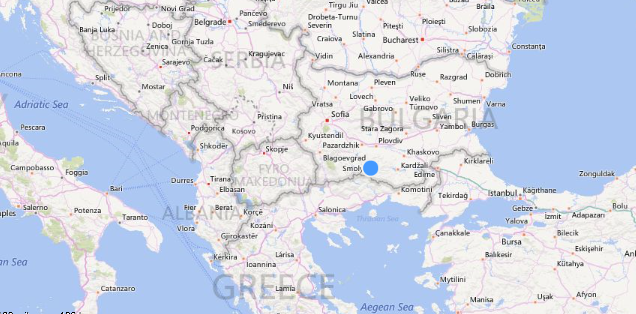
I’m in the village of Shiroka Luka, high in the Rhodope Mountains of South-Central Bulgaria (see blue spot below), for the annual Children’s Theatre School, which LLP Group sponsors.

shiroka luka map

I first came to the village, by chance, in the late Spring of 1988 on a walking holiday with a friend. The village hosts one of the two national folk-music schools which the State (then still a Communist state) supported. We heard music, made some enquiries, and then accompanied the students, in a terrible old bus, to a local village for a concert. How we got back to our hotel, some twenty miles distant, is now lost in a haze of rakiya, a poisonous local fruit brandy.

Ten years later, long after the Communist regime had given up the ghost, my friend returned and discovered a folk-music school in grave decline, but worse, an orphanage (which we hadn’t seen on our first visit), in extreme distress, with insufficient money to feed and clothe its 70 children. My friend then started a charity, supported by other friends all over the world, that provided food, clothes and other necessities. Especially in the early years, this made a vital difference to the lives of hundreds of children, though now, seventeen years later, the situation has improved greatly and the distress, if it remains, is less obvious and less acute.

Some years after my friend’s return, and inspired by his work, I persuaded my business partners and a group of actors, musicians and theatre directors from Sofia, to run an annual theatre school for children from this and other orphanages in the region. This year is the thirteenth year. But today, I and two friends, took a day off from the chaos of the children’s rehearsals and drove to the Eagle’s Eye, a vantage point high above a limestone gorge near the Yagodina Cave, almost on the border with Greece. You can reach it only in the back of a hired off-road vehicle, and for the faint-hearted the journey is a strain. However, the view of the meadows, mountains, villages and deep gorges justifies the mild anxiety.

Our guide was Ilie, by chance a ‘graduate’ of the orphanage in Shiroka Luka. Through an interpreter I asked him about his life then and now. His is a typical story. Ilie still doesn’t know where he was born, or even whether he has brothers or sisters, and the law doesn’t permit him to find out. This is an ever present sadness. He remembers the worst times as the mid-1990s when there wasn’t enough food or fuel to heat the orphanage, and, still to his surprise, no one in the village offered help. He confirms that life for ‘orphans’ is incomparably better now. In fact, there are now only a few orphans in large institutions, the social services department having adopted the European norm of fostering children. It’s hard on those, though, whose early life spans the old and the new systems, since, he says, the children find it hard to adapt to family life after the hurly-burly of communal living, and most long to return to the orphanage.

Ilie

Ilie is in his thirties, and I asked him about the transition from social care to complete independence. For him this came, as it still does for today’s orphans, abruptly, at the end of secondary school. He tells us it was hard to get a job, and that the stigma of the orphanage hangs over him and his orphanage friends still. There are no jobs in this region, there’s no affordable accommodation, and support from the state is provided only for a few months.

Life may be less hard than it was, but tragedies still occur. During the winter of 2013-2014 a friend of Ilie, penniless and homeless, froze to death on the streets of Smolyan, the regional capital. It is hard to understand how this can happen in Europe. There is much still to do in Bulgaria.